
My name is Jovana Tomičić, and this is the story of my dad, Stevan Tomičić, whom we called Buca – a man who was my rock, my hero, my world. Dad was full of life, always ready to share a football story, make the whole house laugh while grilling in the backyard, or teach me and my sister Milana how to make perfect pancakes. His smile was so infectious that it made you forget all your worries. But on December 1, 2020, that smile vanished, and I was left in a silence louder than any scream. This is not just a story of loss – it is a story of negligence, of a system that protects those who fail, and of justice that, in Serbia, remains out of reach for those who deserve it most.
The Day the System Failed
That winter of 2020, my dad was already gravely ill – he had been battling chronic obstructive pulmonary disease for years and had previously undergone surgery for throat cancer. His health was fragile; every breath was a struggle, but he never gave up. He was a fighter, always ready to laugh, to hug us, to tell us a story, or to make those unforgettable pancakes. His strength held us all together – my mom Slavica, Milana, and me.
That morning, around 5 a.m., I woke up from a restless sleep to the sound of my mom’s muffled sobs. Dad was lying in bed, his face ashen gray, his chest barely trembling with the effort to breathe. “He can hardly breathe, Jovana,” Mom whispered, holding the phone in her hands. She quickly called the Emergency Medical Service, her voice trembling with fear. “Please, come immediately, my husband is choking, he can barely breathe!” she pleaded. A team arrived within minutes – I remember the sound of the siren cutting through the early morning silence. Two men in white coats entered our room, examined him, and administered therapy. “He should feel better now,” the doctor said as he packed up his things. They left, leaving us with a hope that quickly began to fade. For a moment, Dad seemed slightly better, or so it appeared.
But as time passed, Dad didn’t get better. On the contrary, every minute that went by made his condition worse. Around 7 a.m., Mom called the emergency services again. I watched her standing in the corner of the room, holding the phone to her ear, tears streaming down her face. “Please, come, he’s not better, he’s still struggling to breathe,” she begged. On the other end of the line, I heard a cold voice: “Measure his blood pressure and let us know.” Mom shook her head in despair. “We don’t have a blood pressure monitor, we can’t do that!” she said. No one came. Dad lay in bed, each breath a silent cry for help. His eyes, always so warm and full of life, were now clouded, as if he were slowly slipping away from his body. I couldn’t bear to see him like that – my dad, my giant, had become so fragile, and I was powerless to help.
By 2 p.m., his condition fluctuated – at times he seemed better, at others he struggled to breathe. Mom called a third time. “Please, come, my husband is dying!” she pleaded into the phone. The doctor on the other end asked about his blood pressure again, as if he hadn’t heard our pleas. “We don’t have a monitor, we can’t measure his blood pressure!” Mom replied, her voice cracking with desperation. “Then bring him in,” the doctor said, as if that were the most reasonable solution. “How can we bring him?! He can barely breathe, he can’t even stand, and we can’t carry him!” Mom explained. She begged, she pleaded, but nothing. No one came. Every second of waiting felt like an eternity. I remember kneeling by Dad’s bedside, holding his hand, my tears falling onto his fingers. “Dad, please, hold on,” I whispered, but he only groaned softly, fighting for every breath.
By 5:30 p.m., Dad’s condition had rapidly deteriorated. His face had completely changed color, and he began to lose consciousness. I grabbed the phone and called the emergency services one last time. “My dad is choking, he’s dying, please come now!” I screamed, no longer caring about anything. The voice on the other end tried to calm me down. A neighbor who had come over in the meantime took the phone and explained the situation. Finally, we heard from the other side: “We’re coming.” But it was too late. When they arrived at 5:58 p.m., Dad had already stopped breathing. I remember that moment as if it were in slow motion – the doctor knelt beside Dad and began resuscitation, but it was too late. The team quickly left the apartment without a single word. They didn’t even offer their condolences.
Dad was still warm, but his eyes, which had always looked at me with so much love, were now closed – forever. In that moment, I realized I would never hear his voice again, never hear him call me “daughter” while placing a plate of pancakes in front of me. My world collapsed. I knelt beside him, holding his hand, as my tears fell onto his fingers. “Dad, please, stay,” I sobbed, but he couldn’t hear me. The silence swallowed everything – his laughter, his stories, his breath. In that moment, as I watched my dad fade away, I knew that the system that was supposed to save him was the one that had killed him. Mom, Milana, and I were left alone in a house that suddenly felt vast and empty, with a pain that’s impossible to describe.
Negligence That Cannot Be Forgiven
This was not an accident. This was negligence – pure, cruel negligence that cost my dad his life. In any remotely normal country, such a failure would not go unpunished. In countries where the healthcare system functions, where doctors understand the gravity of their calling, Dad would have been taken to the hospital after the first call at 5 a.m. His condition – chronic lung disease, difficulty breathing – was a clear warning that his life was in danger. In Germany or Sweden, a doctor would have immediately recognized the severity of the situation and sent a team with the proper equipment. In Australia, there’s a system of independent investigations for every death related to medical negligence – families receive a transparent process, and doctors face accountability. In the UK, the National Health Service has strict protocols: if a patient shows signs of a serious condition, like difficulty breathing, a team is dispatched immediately, and if a doctor fails to recognize the urgency, they face serious consequences, including suspension and legal action.
But not in Serbia. Here, my dad became a statistic, another victim of a system that protects its doctors more than its patients. The doctor who ignored our desperate calls three times, who failed to recognize the signs of heart failure, who said “bring him in” instead of sending a team – that doctor still works, undisturbed. And all of this is enabled by a legal vacuum that has persisted for years because the Minister of Health failed to fulfill their legal obligation. Article 83, paragraph 4 of the Healthcare Law mandates that the Minister establish regulations on the organization and operation of emergency services, including protocols, within 18 months of the law’s adoption in 2019. Six years have passed, and those regulations still don’t exist. In this legal vacuum, a system of irresponsibility has been created where no one faces consequences – neither doctors nor institutions. Article 62 of the same law requires healthcare institutions to provide emergency care “in accordance with the law,” but that term is inapplicable because the necessary bylaws were never enacted. In Serbia, the Medical Chamber isn’t there to protect patients – it’s there to protect its members, even when their failures kill. According to data from non-governmental organizations, thousands of families in Serbia are left without justice each year due to medical negligence, and most cases never even reach a courtroom. How is it possible that a man who can barely breathe, who is choking, is left to die at home because his family “doesn’t have a blood pressure monitor”? How is it possible that a doctor fails to recognize the urgency of the situation, even if resources are limited? The pandemic is not an excuse – the pandemic is all the more reason for doctors to fight for every life, especially for the most vulnerable, like my dad. But in Serbia, where accountability is a foreign concept, lives like my dad’s are forgotten, and families are left to bear the pain alone.
The Fight for Justice with the “Right to Life – Meri” Movement
We couldn’t accept that Dad died because no one came in time. I knew we had to seek accountability. The doctor who was on duty that day, who ignored our desperate calls, had to answer for it. We filed a request to initiate a disciplinary procedure with the Serbian Medical Chamber, hoping that justice would at least partially ease our pain. But that path was not easy – it was full of obstacles we could never have overcome alone. The “Right to Life – Meri” Movement played a crucial role in that fight. They weren’t just support – they were our backbone in every sense. They gathered all the necessary documentation, from medical reports to testimonies, drafted the appeal that was later accepted by the Supreme Court of Honor, and provided a lawyer to represent our case. Without them, we wouldn’t have had the strength or the knowledge to navigate the bureaucratic maze that was supposed to bring us justice.
At first, it all seemed hopeless. The Court of Honor of the Regional Medical Chamber of Vojvodina ruled that our request was unfounded.
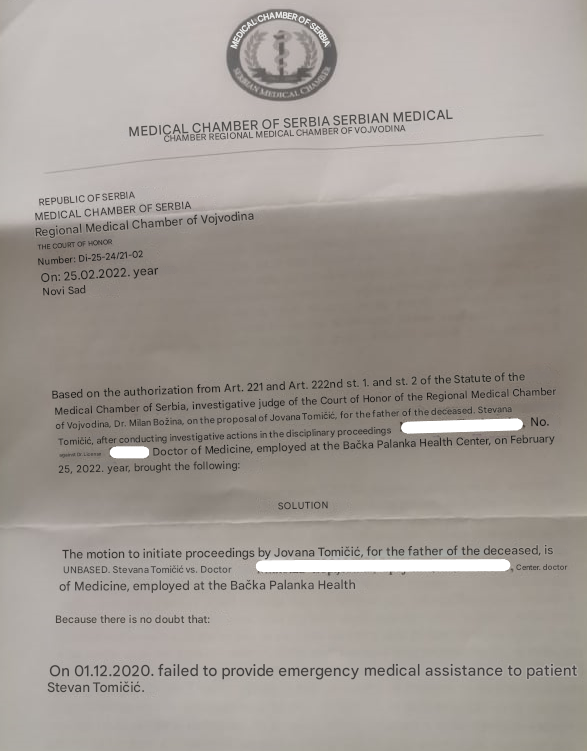
They claimed the doctor hadn’t violated any rules, that he had acted in accordance with protocols, even though they admitted the Emergency Medical Service was overwhelmed that day due to the pandemic. In their reasoning, I heard excuses: that we couldn’t measure his blood pressure, that Mom didn’t say she was COVID-positive. As if that justified the negligence! I was furious. How could they say it was “unfounded” when my dad died waiting for help that never came? But thanks to the “Meri” Movement, we didn’t give up – they drafted an appeal and submitted it to the Supreme Court of Honor.
Our persistence and their help paid off. After the appeal, the Supreme Court of Honor recognized that there were grounds for the procedure, and the case was returned to the Regional Medical Chamber. Finally, on November 18, 2022, the Court of Honor issued a ruling: the doctor was found responsible. It was determined that he failed to recognize the signs of heart failure, despite warnings from Mom, Milana, me, and the nurse about Dad’s critical condition. He didn’t go to the scene, didn’t provide the emergency care that was necessary. The court believed our testimonies and the testimony of our neighbor Igor, who witnessed our despair that day. The penalty? A public reprimand. Just that – words on paper. Though it was a lenient penalty, we were satisfied – not because we sought revenge, but because we wanted someone to finally say there was accountability, that Dad’s life hadn’t gone unnoticed.

I thought it was at least a small step toward justice. But even that didn’t last.
The system had other plans. The doctor appealed the decision, and on December 23, 2022, the Supreme Court of Honor of the Serbian Medical Chamber issued a new ruling – the initial decision was overturned, and the procedure was terminated due to the statute of limitations. Two years after Dad’s passing, on December 1, 2022, the deadline for initiating the procedure had expired. This was no coincidence – it was a deliberate strategy. The system dragged out the process, exhausting us with endless paperwork, rejections, and appeals, until the case became time-barred. Every step was designed to break us, to force us to give up, to ensure justice never arrived. From the initial rejection of our request, through the lies about audio recordings, to the final termination of the procedure – it was all part of a plan to protect the guilty and leave us, the family, drained and without justice. The Supreme Court even admitted that the first-instance court hadn’t sufficiently established the facts – whether the doctor could have come at all, whether triage during the pandemic was an obstacle, whether the failure directly led to Dad’s death. But instead of seeking the truth, they chose the statute of limitations – the easiest way out for a system that refuses accountability.

Manipulation and Concealment of Evidence – A Shameful System
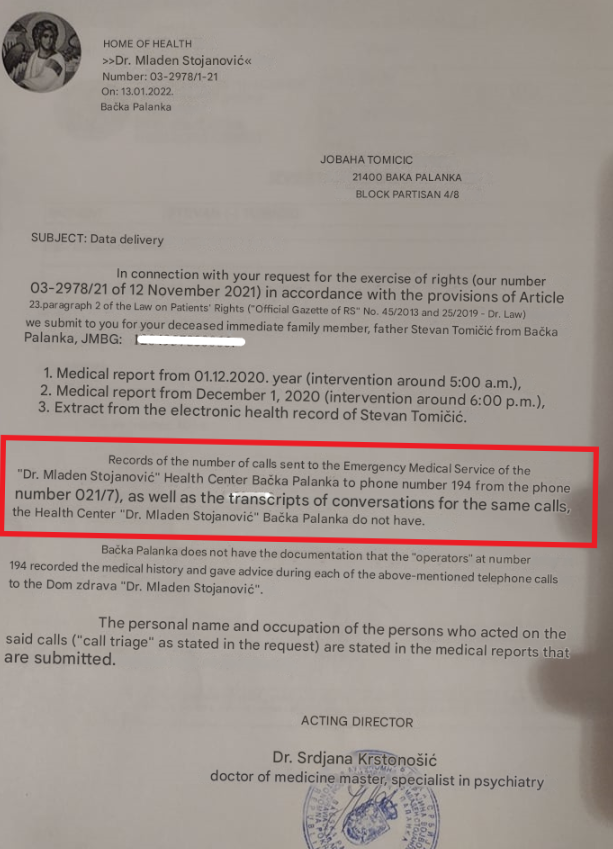
As we fought for justice, we encountered yet another disgrace of the system – blatant manipulation and concealment of evidence that could have revealed the truth about the negligence that took my dad’s life. The “Right to Life – Meri” Movement requested audio recordings of our calls to the emergency services from December 1, 2020 – recordings that would have shown our despair, our screams, our pleas for help that were ignored. Those recordings would have been undeniable proof that the doctor knew how much danger Dad was in, yet did nothing. In their first response, on September 22, 2021, the Bačka Palanka Health Center clearly stated that all calls to the number 194 are recorded. That gave us hope – we would finally have proof of our desperate calls, Mom’s pleading, my screams that Dad was dying.

But when we officially requested those recordings or their transcripts in January 2022, the Health Center had the audacity to say they didn’t have them – no audio recordings, no transcripts, not even a record of the calls. How is it possible that they first claim the calls are recorded, and then, when we request them, say they don’t exist?
This is not a coincidence – this is deliberate manipulation, a sinister concealment of evidence to protect the doctor who failed to do his job. The Health Center lied, toying with our pain, using bureaucratic excuses to hide the truth. How is it possible that there’s no record of a patient who called multiple times that day, when a team even responded on the scene? How is it possible that an Emergency Medical Service doesn’t have recording equipment in the 21st century, when they themselves admitted that calls are recorded? This is a disgrace, an insult to every family seeking justice. In countries where justice works, those recordings would have been key evidence, and institutions would have been punished for lying and concealing. In Serbia? In Serbia, evidence disappears, lies pile up, and families are left without answers, forced to fight alone against a wall of bureaucratic indifference.
Justice That Never Comes – A System That Protects Negligence
The European Court of Human Rights states that the denial of justice can be a violation of human rights, as the family is left in a state of humiliation and helplessness. That’s exactly how I feel. The Code of Medical Ethics of the Serbian Medical Chamber, in Article 8, states that every doctor is obliged to provide emergency care to a person whose life is in danger, whether on duty or not. Article 9 mandates that doctors must provide assistance in extraordinary circumstances, like a pandemic. My dad was in danger – why didn’t anyone come? Why are excuses about triage and the pandemic enough to let a person’s life be forgotten?
In any normal country, a case like this would be taken seriously. In the UK, for example, the National Health Service (NHS) has strict protocols for emergencies – if a patient shows signs of a serious condition, like difficulty breathing, a team is dispatched immediately, and if a doctor fails to recognize the urgency, they face serious consequences, including suspension and legal action. In Australia, there’s a system of independent investigations for every death related to medical negligence, and families have the right to a transparent process and compensation. In Serbia? In Serbia, the case is dismissed due to the “statute of limitations,” and the doctor who didn’t come in time continues to work, undisturbed, while we, the families, bear the burden of loss. The system in Serbia isn’t designed to protect patients – it’s designed to protect those who fail. The statute of limitations is just an excuse, another way to avoid accountability. How is it possible that two years aren’t enough to establish the truth, to deliver justice? How is it possible that my dad’s life is worth less than bureaucratic deadlines?
A Void That No One Can Fill
As I write this, I’m holding Dad’s football – the one we used to play with in the backyard. It still smells like him. Every memory of Dad hurts, but it also warms my heart. I remember how he made pancakes, how he talked about football with so much passion, how he always had time for us. But every memory also carries bitterness – because I know he could still be here if someone had done their job. The system betrayed me. The doctor who didn’t come still works, still wears his white coat, while I live every day with a void that no one can fill.
When I learned that the ruling had been overturned, I stood in the kitchen, holding Dad’s coffee mug – the one he always used. My hands were trembling, tears streaming down my face. Mom sat at the table, staring at the floor in silence, while Milana tried to comfort me: “Jovana, don’t give up, we’ll keep fighting.” But how do I fight when they keep pulling the rug out from under me? When the system, which is supposed to protect us, tells me that Dad’s life isn’t important enough for the facts to be “sufficiently established”? That day, I realized – justice in this country isn’t about truth; it’s about a game that never ends.
A Call to Action
This is not just my story. This is the story of thousands of families in Serbia who have lost a loved one because the system wasn’t there when it was needed. That’s why I joined the “Right to Life – MERI” Movement. Together, we fight for justice, for change, for a system that will protect rather than betray. I call on all of you who have experienced similar pain, who have a story of loss due to the system’s negligence – share it with us. In the name of those who can no longer speak, we are now writing.
Share this story. Let’s show that our loved ones are not just numbers in statistics, but people who deserved to live. Dad, I promise you – I won’t give up. Your smile guides me, and I will fight as long as I breathe.
To fully understand how a system designed to save lives turned into one that profits from silence,
read the companion investigation:
Earning While People Die
LIVES LOST IN THE SILENCE OF THE SYSTEM OBLIGE US TO ENSURE THAT SILENCE IS NEVER LEFT WITHOUT AN ANSWER AGAIN!

