This story reveals a systemic failure in emergency healthcare that cost Marinko Rudakov his life. This is not just a personal tragedy; it is a consequence of a systemic emergency healthcare failure that continues to endanger lives across Serbia.
My father, Marinko Rudakov, was born on January 24, 1955, in Bogatić.
He was a man of the old school—true to his word, his work, and his honesty. He didn’t know how to say no when someone asked for help. He was there—when a neighbor’s pipe burst, when someone needed beams cut for a house, when someone needed a ride to town. He worked when others rested, helped even when no one asked. He was the foundation of our home and a pillar for everyone who knew him.
If there was a word to describe dignity—it was Marinko.
A Man Who Helped Everyone, Left Without Help
But when he needed help—he didn’t get it.
When he collapsed in the night, struggling for breath and life, the system he had paid into for decades turned its back on him. While we, his daughters, called, begged, and explained that we couldn’t carry him alone, that he was trembling, fighting for life—they told us not to call again. They said they don’t come out at night. To “figure it out.” That there was snow. That it wasn’t their problem.
And to us—to us, the state delivered a slap in the face instead of help.
A slap of silence. A slap of indifference that echoes through the closed doors of clinics and cold offices. A slap of being ignored, behind which hide those who swore to help—now hiding behind their positions of power.
This is a story about a country where help depends on the time of day, the mood of the dispatcher, and how loudly you shout.
This is a story about a man who was there for others his whole life. And when he fell—there was no one to lift him up.
A Teacher of Life
They called him Marinko Rus. He was the only circular saw craftsman in all of Mačva and Srem. His hands were rough from boards and machines, but gentle when he woke us for school. He had his little truck full of tools and timber, driving from village to village—through summer dust and winter ice—never late. To others, he was a craftsman. To us—a hero.
My father wasn’t an educated man in the academic sense. But he studied life like a book. And he kept opening that book for us. He taught us to be honest, hardworking, and to never turn away when someone needed help.
He used to say:
“Honesty isn’t a job—it’s a duty. If you lose it, everything you have is worthless.”
I remember one winter, I was maybe seven years old. The snow was knee-deep, we didn’t go to school, and Dad came home early from work because a job in a village near Šabac fell through. Instead of resting, he grabbed an axe and a shovel and started clearing snow for the neighbors. My sister and I watched him through the window.
Mom said:
“Come on, girls, help your dad, don’t just watch.”
We put on those thick hats and gloves that always smelled of wood and glue, and went outside.
Dad stopped, leaned on his shovel, looked at us, and said:
“See, this is how you earn respect. Not with words, but with your hands. This snow won’t teach you anything if someone else clears it for you.”
That day, we didn’t just clear snow. We learned not to choose the easy path. To respect work. And to never be ashamed of being humble.
That evening, as we dried off by the stove, my sister asked:
“Dad, do your hands hurt when you work all day?”
And he replied:
“They do, sweetheart. But it’s a good pain. It’s the kind of pain you know you’ve earned.”

The Night the Silence Began
It was an ordinary winter night in Glušci, January 9, 2024.
Snow quietly blanketed the yards, and the cold crept under the windows. Inside, the warmth of a family evening filled the house. The kids were in pajamas, laughing and playing, while dinner simmered on the stove. The TV softly played news no one listened to.
Dad sat in his favorite armchair, tired but content, watching his grandchildren play. His presence brought peace and security.
After dinner, the kids calmed down. I kissed them goodnight and tucked them into bed, promising that Grandpa would make their favorite pancakes tomorrow.
After they fell asleep, I stayed with Dad in the living room.
At one point, he said quietly:
“Something’s stabbing me…”—pointing to the right side of his stomach.
His gaze was hazy, his face gray, sweat beading on his forehead.
I helped him lie down. Gave him a painkiller. Covered him.
I sat by his bed, trying to stay calm.
In my mind, I thought it was just a passing pain. That it would go away. That we’d talk in the morning about how he scared us.
But the pain grew worse.
At one point, he tried to stand. He lost his balance and fell, hitting his head on the floor.
Blood. Silence. And fear.
Do you know that feeling when you’re a child, something breaks, something happens, and there are no adults around?
And you wonder—what now? Who do I turn to?
That’s how I felt that night.
Except I wasn’t a child anymore.
And it wasn’t a toy that was broken—it was a person. My father.
And there were no adults to help.
Only me. And my fear.
Dad lay on the floor, blood dripping down his temple. He was breathing heavily, in fits and starts.
“Something’s wrong, sweetheart…” he said.
My hands were shaking. My legs buckled.
I called the emergency services. I pleaded. I explained.
Telling them I was alone, that there was no transportation, that I couldn’t lift him, that he was a heavy man, and that my father was dying.
On the other end—coldness. Indifference.
“What do you want? There’s no ambulance. We don’t drive at night. Wait until morning.”
Wait until morning.
As if pain has a schedule.
As if death knows when it’s allowed to come.
I tried to reason with them. To pull them into my reality.
Into the room where a man was dying before his daughter’s eyes.
But they were already in their own—protected by regulations, shielded by counters, secure in their irresponsibility.
And so I was left—alone.
With a father losing strength. And children sleeping, unaware that their world was collapsing.
I sat on the floor. Watched him tremble, try to say something but fail.
I covered him again.
Adjusted his pillow.
Held his hand—as if my palm could give him the strength the system refused.
And inside, everything in me was screaming.
Helplessness was choking me.
As if I were suffocating alongside him.
Moments That Are Never Forgotten
Do you know what humiliation is?
It’s not an insult on the street. It’s not when someone says something mean.
Humiliation is watching your father die—and those paid to help refuse to even try.
Humiliation is when they tell you:
“We don’t go out after seven.”
Humiliation is when your heart is breaking—and they tell you to wait until morning.
Humiliation is when you pick up the phone—and no one answers. Or worse—they answer to reject you.
No, that’s not silence.
Silence can be gentle.
This wasn’t silence.
This was indifference.
Heartless. Cruel. Systematic.
I sat on the floor beside him. Blood trickled from his head. His heart stopped.
And I just breathed—for both of us. And cried—without tears.
I didn’t have the luxury of breaking down. I didn’t have the right to panic. Because no one else was left.
And no—we weren’t asking for a miracle.
We weren’t asking them to save a life that maybe couldn’t be saved.
We were asking for something else.
Dignity.
For someone to try.
For someone to come.
For someone to at least see.
And we got silence. And one message, heavier than all:
“You’re not worth coming for.”
A Morning Without Justice
A lie on paper. Silence in the system.
Morning came—but help didn’t.
A few kilometers from the health center, my father’s body still lay where he took his last breath.
No examination. No confirmation. No visit from those who, the night before, said: “Wait until morning.”
That morning came.
But they—didn’t.
That morning came.
But no one—no one—came.
Dad died at two in the morning. And we waited.
For hours. Naively, humanly—believing that someone would still come.
That someone would at least take pity.
That somewhere, behind those closed doors, there was someone who wouldn’t let a man remain dead and forgotten.
Every new hour brought new hope—and a new wound.
When the System Kills a Second Time
It was 5 p.m. when I walked into the Bogatić Health Center to report the death.
Fourteen hours—dead.
Fourteen hours—of silence.
Fourteen hours—of shame.
At the counter, behind the desk, I was met with a cold wall of meaningless words.
They asked me: “Are you planning to sue anyone?”
That hadn’t even crossed my mind.
In my hand, I held the details of my father’s death, and on my face, the traces of a sleepless night.
I wasn’t looking for blame.
I was looking for truth.
They gave me a death certificate.
On the paper, it said:“I was born a winner.
“Based on a detailed examination of the unembalmed body on January 10, 2024, I confirm the death.”
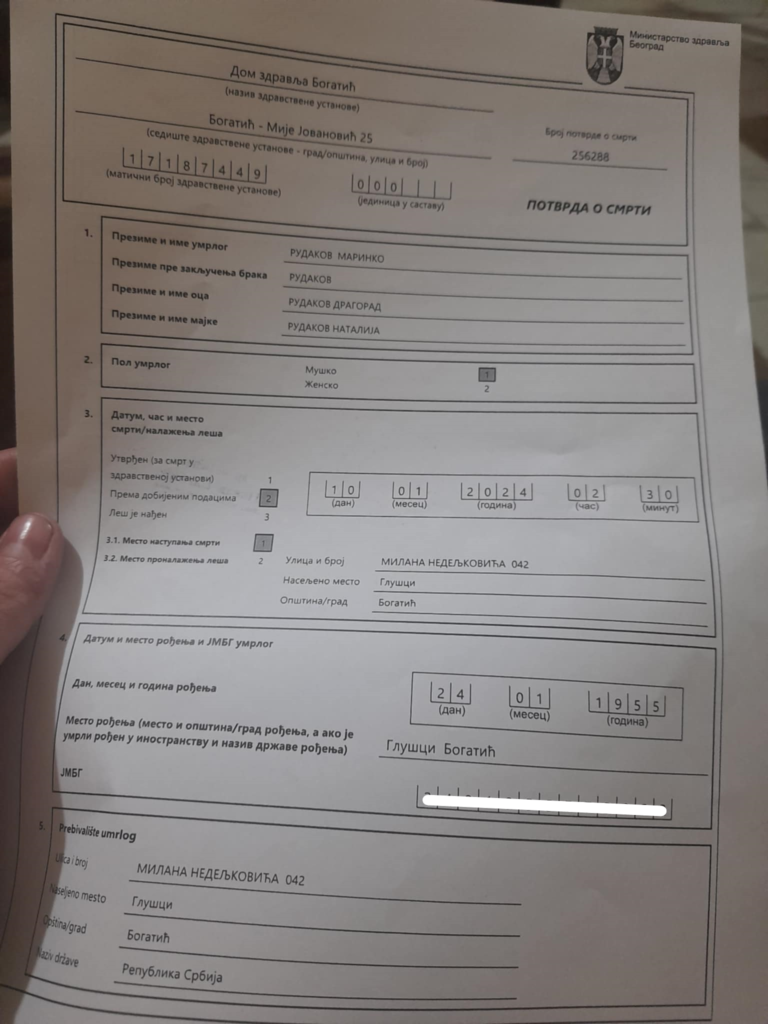
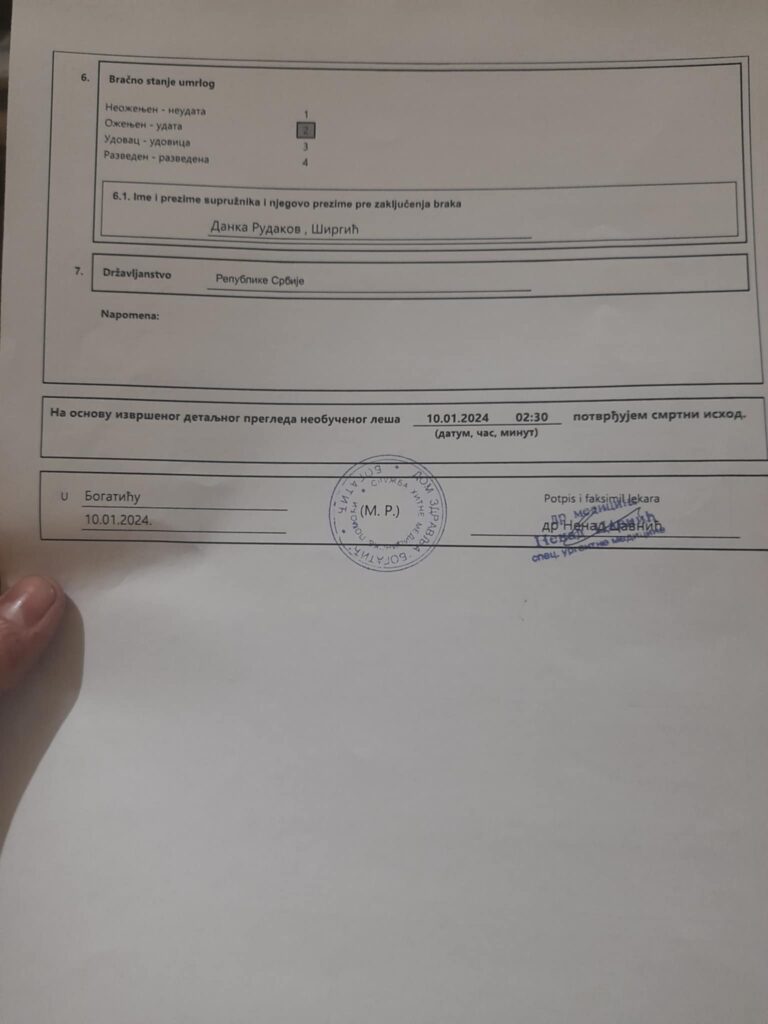
A lie.
None of that happened.
No one came.
No one looked at my father.
No one touched him.
Not post-mortem—not humanly.
The body they refused to save, they now crossed out as if they had done everything.
They closed the case—with a fictional visit.
A sealed lie in a form that goes to the archives, not to the heart.
In a country where you die before your daughter’s eyes—
And doctors write that they examined you.
Where a non-existent visit becomes an official one.
Where it’s easier to lie than to admit.
And no one, no one will be held accountable.
Because the system is complete.
Designed to protect its own—not yours.
To wash its hands—even when they’re bloody.
When the system turns a deaf ear, it doesn’t say “sorry.”
It writes a report.
It underlines a sentence.
It shields itself from the truth.
Because the truth is dangerous.
Because the truth tears down walls.
My father was left to die.
And then they tried to mask the truth.
As if a life is only worth as much as the paper it’s replaced with.
But I—I will keep that paper.
Not as proof of death.
But as proof of a lie.
After Death—Silence. Arrogance. Lies.
When a person dies in your arms, time stops.
But in this country—what kills you doesn’t stop with death.
What defeats you completely comes after.
My father was dead.
No one came to examine him.
No one came to take him away.
After death—the silence continued.
Not the quiet kind that comes when everyone leaves the funeral.
But the sinister silence of institutions.
The silence that sounds like a rehearsed phrase.
The silence behind the closed doors of offices, behind the words “it’s not our fault,” “we followed the rules.”
And what rulebooks did you follow?
The Ministry of Health was legally obligated, as of October 2020, to adopt bylaws and regulations on the organization of emergency services in accordance with the Healthcare Law.
They didn’t adopt them.
Four years later—they still don’t exist.
So when they tell us they “followed protocol,” we know they’re lying.
Because there is no protocol.
No rules, no oversight, no accountability.
A Legal Void—Death Without Justice
The system that should protect—has itself created a legal vacuum.
And in that vacuum—lives disappear. Without reaction. Without answers.
And one more question burns in my chest:
If Marinko Rudakov had lived in Belgrade, Novi Sad, or Niš—would he be alive today?
Because in those cities—emergency services do come.
Because in those cities—someone might have tried.
In small places, life is worth less.
In villages—there’s no guaranteed right to help.
As if the constitution doesn’t apply equally to all.
As if lives have a ZIP code.
And Then—Mockery as a Response
A few days after my father’s death, a local news portal published a brief article. The headline was plain, dry, almost bureaucratic: “Marinko Rudakov from Glušci Passes Away.” People from the area shared the link. Wrote comments. Some offered condolences. Some asked what happened.
And then—a comment appeared that wasn’t ordinary.
It was written by the head of the local emergency service.
Without a trace of respect. Without dignity. Without a shred of responsibility.
First, he wrote:
“You fell for the wrong bait ”
And then, in response to a comment saying, “See you in court,” he shrugged and replied:
“I was born a winner. ”
While we were still burying our father—they were mocking us.
While we wept over his body—they were writing with a smile.
This isn’t just cynicism. It’s a symbol of a system that no longer knows what shame is. Of a service that no longer knows what “urgent” means, or what “human” means. It’s the tone of the confident—who know no one will hold them accountable. It’s the smile of a system that knows it’s protected.
It’s a smile that kills a second time.
What’s Left for the Family?
To piece things together.
To explain to the children why Grandpa didn’t make it to morning.
To fight the guilt they don’t deserve.
To wonder—if they could have done more, even though they did everything.
And to feel that in this country, there’s no justice for everyone.
No equality in life. And even less—in death.
We Won’t Stay Silent
But we’re not alone.
The movement “Right to Life – MERI” didn’t let this crime be buried in silence.
It was there to raise its voice.
To gather evidence.
To remind everyone that Marinko isn’t a number in a statistic.
To say, on behalf of all of us:
“We won’t stay silent.”
Because every silence that isn’t broken—becomes the rule.
And we don’t accept rules that kill.

Voices of Justice — Stories That Must Not Remain Untold
This is the third story in the series “Voices of Justice”, through which the movement “Right to Life – MERI” documents the testimonies of families who lost their loved ones due to systemic failures in emergency medical services — and due to the deadly silence that followed.
The first story, about the death of Stevan Tomičić from Bačka Palanka, who was left without emergency medical assistance despite multiple calls for help, can be read here:
The second story, about the death of Merita Bekirovski and the beginning of the fight that launched the entire movement, is available here:
This third story comes from Bogatić. It brings the voice of the daughter of Marinko Rudakov — a man who spent his life helping others, but was left to die alone in his own home, without assistance, without examination, and without accountability from those who should have responded.
LIVES LOST IN THE SILENCE OF THE SYSTEM OBLIGE US TO ENSURE THAT THIS SILENCE IS NEVER MET WITHOUT AN ANSWER AGAIN!

