
A Detailed Analysis of Systemic Misuse of Emergency Medical Resources, Funds, and Staffing in Belgrade’s EMS Institute. How Over 3,500 Hours of Commercial Activities Diverted Public EMS Teams from Citizens in Need
1. Introduction
Due to systemic abuse of personnel, resources, and misuse of public funds, the legal team of the Movement Right to Life – MERI today submitted an official request to the Republic Fund for Health Insurance for an urgent and comprehensive audit of the operations of the Belgrade Emergency Medical Institute for the period from 01.01–01.09.2025.
The request was submitted based on an extensive analysis conducted by our team, which shows systemic violations of the law, contractual obligations, and gross abuse of personnel and equipment financed from mandatory health insurance funds.
2. Budget Account vs. Own Funds Account
At the outset, it is important to clarify the difference between the two types of accounts through which the Belgrade Emergency Medical Institute operates.
2.1. Budget Account (840-0000000619661-53)
The “budget account” is the account to which the healthcare institution receives funds provided by the RFZO or the budget of the Republic of Serbia for performing its basic, legally defined activities.
From this account, salaries of doctors, technicians, and drivers are financed, as well as the operation of ambulance vehicles, fuel, equipment, consumables, and all activities that represent public services available to citizens.
2.2. Own Funds Account (840-0000000619667-35)
In contrast, the “own funds account” represents the account to which the institution deposits revenues it earns itself, outside the framework of public financing. These are funds obtained from:
- providing commercial services (e.g., duties at events),
- charging for sanitary transports not covered by insurance,
- revenues from contracts with third parties,
- donations and other sources not from the RFZO.
2.3. Why this distinction matters
The costs of team operations fall on the budget account (RFZO), while all revenue from commercial activities flows to the Institute’s own funds account — meaning that commercial revenue is practically 100% profit for the Institute, achieved using public resources.
This relationship underlies all further irregularities documented by the MERI Movement below.
3. What Did We Discover?
Documents and financial data we collected show the following:
3.1. Massive commercial engagements
- The Institute performed 3,544.5 hours of commercial engagements in 8 months.
- This equals more than one full year of work for one medical team.
- On average, citizens of Belgrade were deprived of 14.6 hours of emergency aid every day — equivalent to one full team per day.
3.2. Commercial work despite staff shortages
While the city has only 23–25 teams instead of the legally prescribed 46, the Institute simultaneously sent teams to:
- private events,
- sports matches,
- festivals, concerts,
- fairs,
- film shootings,
- large commercial contracts such as duties at Ada Ciganlija.
3.3. Revenue
Revenue amounted to:
- 16,576,005 RSD excluding VAT
- 19,891,206 RSD including VAT
All this money was deposited into the Institute’s own funds account, while:
- salaries,
- contributions,
- drivers,
- medical technicians,
- doctors,
- ambulances,
- fuel,
- equipment
were financed from RFZO funds — i.e., money from all insured persons.
In other words: Citizens finance the costs, the Institute keeps the revenue.
4. No “Excess Capacity” — the Institute Operates with a 50% Deficit
According to the official document of the Ministry of Health:
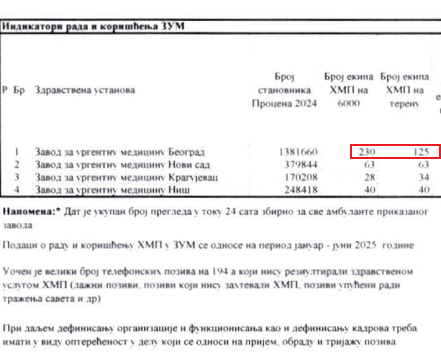
- The Institute must have 46 teams per shift, or 230 teams in total (5 shifts).
- In reality, it has 23–25 teams per shift, a shortage of 45–50%.
At the same time:
- at least 21 doctors, 24 drivers, and 40 technicians are banned from field work due to occupational medicine findings,
- the Institute objectively cannot meet the norms,
- yet it still redirects operational personnel to commercial activities.
4.1. Direct legal violations
This directly violates:
- Article 190 of the Health Insurance Law,
- Article 204 of the Health Insurance Law,
- Article 11 of the Contracting Rulebook,
- Article 60 of the Health Protection Law.
5. Inefficiency and Unfair Competition: The Ada Ciganlija Case
During part of June, all of July, and August, the Institute daily allocated:
- 3 doctors,
- 4 technicians,
- 2 drivers,
- 2 ambulance vehicles
to commercial duties at Ada Ciganlija.
Due to shift work, this means monthly:
- 6 doctors,
- 8 technicians,
- 4 drivers
fewer for the citizens of Belgrade.

5.1. Financial results
For 68 days of duties, the Institute earned:
- 4,999,360 RSD (73,520 RSD/day)
If the Institute paid the costs itself, the minimum cost would be:
- 4,263,094.08 RSD
Real costs would leave about:
- ≈ 10,000 RSD/day profit
But because RFZO finances the entire operation, the Institute realizes:
- 73,520 RSD/day as pure profit
This means the Institute achieves profit thanks to someone else’s costs while citizens are left without emergency teams.
5.2. Unfair competition
Private medical services bear all costs themselves, while the Institute operates commercially with RFZO subsidies.
Contract with JP Ada Ciganlija
The contract clearly states that simultaneously engaged are:
- one field team (doctor, technician, driver),
- two outpatient teams (doctor + technician),
- one transport team (technician + driver).
Four teams per day for 68 days.
6. Misuse of Public Funds
Analysis of financial flows showed:
- payments of salaries from the budget (RFZO) account for personnel who worked commercial jobs,
- deposit of all commercial revenues to the own funds account,
- transfers of money from budget to own account without clear basis,
- reverse transfers without RFZO approval.
This represents:
- violation of the Budget System Law,
- misuse of RFZO funds,
- grounds for misdemeanor and criminal proceedings.

7. Invoices for Commercial Engagements – January–August 2025
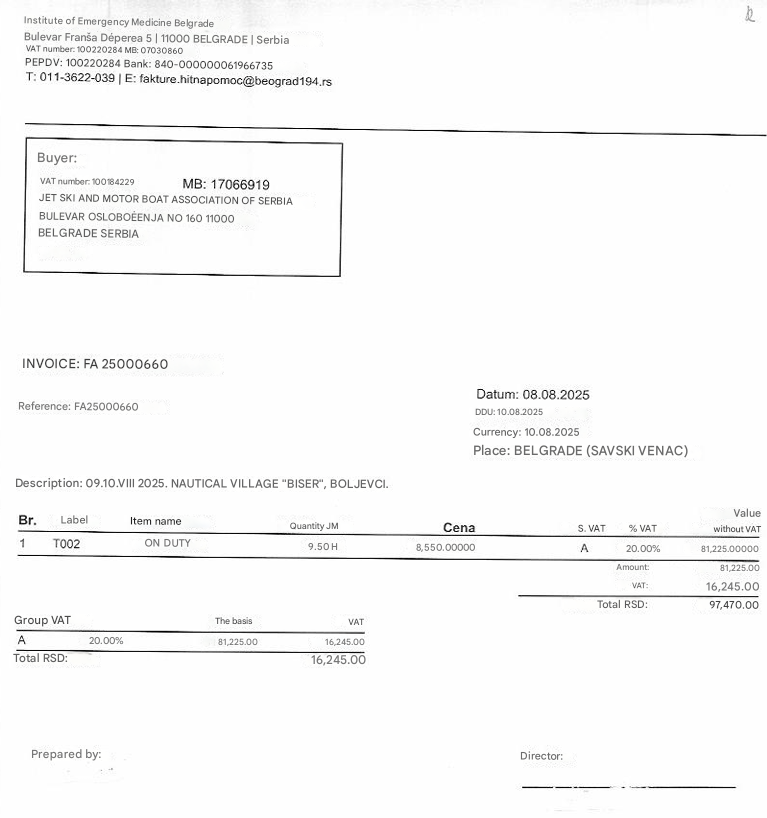
To provide the public with a complete and transparent insight into the scope of commercial activities of the Belgrade Emergency Medical Institute, the MERI Movement publishes the complete set of invoices issued from January 1 to September 1, 2025.
Фактуре (Download)
7.1. Revenue based on these invoices
- 16,576,005 RSD excluding VAT
- 19,891,206 RSD including VAT
The revenue was entirely deposited into the own funds account, while personnel and vehicles used were financed exclusively from RFZO funds.
7.2. Total commercial revenue (first 8 months of 2025)
- 28,420,611.11 RSD
This raises the key question:
Does the Emergency Medical Institute partially function as a private enterprise within the public system – financed by citizens’ money?
8. What Is the Essence of the Problem?
The Institute’s commercial engagements have direct consequences on citizens’ lives.
Due to the shortage of teams — further deepened by daily redirection of resources — dispatchers increasingly refuse to send teams, citing:
- “symptoms do not indicate an emergency,”
- “assessment is that a team is not needed,”
- “not for emergency aid.”
However:
- the system lacks clear, mandatory protocols for receiving and processing calls,
- the number of teams is halved compared to the legal minimum.
“Professional assessment” often serves as justification for capacity shortages — not medical evaluation.
Consequences for citizens
- neglect of urgent symptoms,
- downplaying secondary symptoms,
- worsening of conditions,
- preventable fatalities,
- dangerous delays in time-critical interventions.
This is a systemic pattern.
9. Call for Urgent Reaction
RFZO
- stop redirecting personnel financed by RFZO to commercial activities,
- conduct an extraordinary audit of all contracts, invoices, engagement hours, and account transfers.
Ministry of Health
- enforce regulations requiring 46 teams per shift,
- introduce mandatory protocols for receiving and processing calls.
Prosecutor’s Office & State Audit Institution
- investigate misuse of RFZO funds,
- examine unfair competition and abuse of public resources.
Health and Family Committee of the National Assembly
- respond to the MERI Movement’s request for a public debate on emergency aid operations, resource redirection, and consequences for citizens’ lives.
Institutions routinely call for dialogue, yet on this topic — central to public safety — none have been willing to engage.
The MERI Movement believes it is time for that to change.

