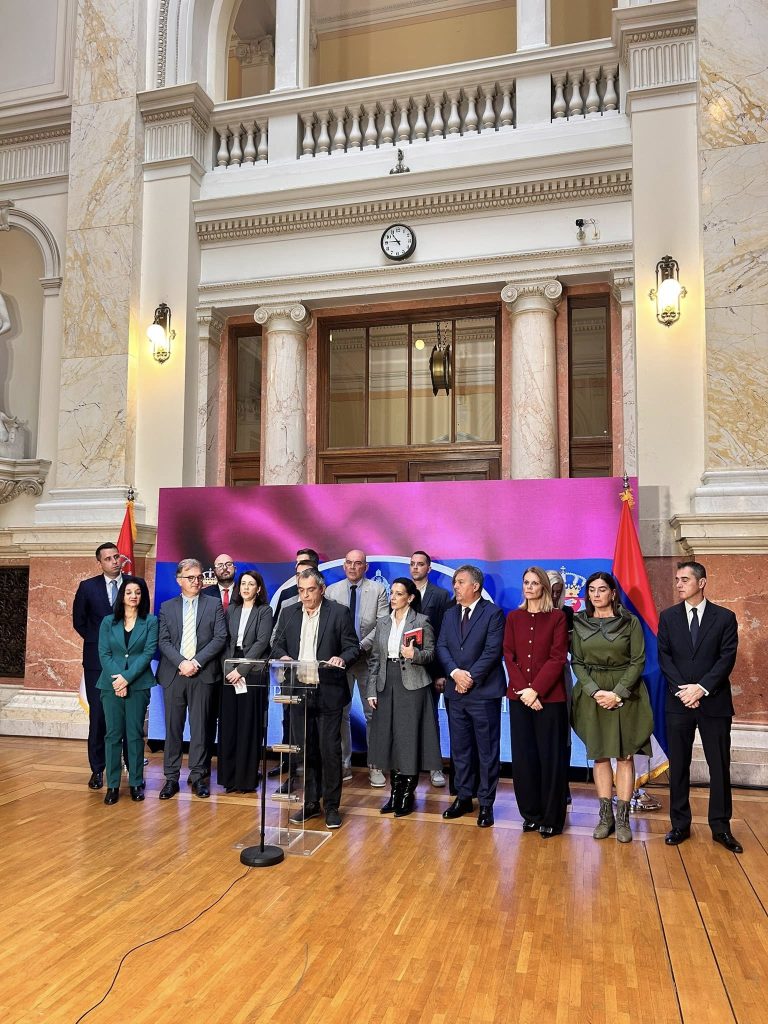
On 21 October 2025, Pravo na život – MERI ( Movement Right to Life – MERI), together with a group of 60 Members of Parliament of the National Assembly of the Republic of Serbia, submitted to the Constitutional Court of Serbia:
- a Proposal for the Assessment of Constitutionality and Legality, submitted by Members of Parliament, and
- a Constitutional Initiative, submitted by the civil society organization Pravo na život – MERI,
both challenging the Rulebook on the Manner and Organization of Providing Emergency Medical Assistance (“Official Gazette of RS”, No. 79/2025).
📄 The full texts Rulebook on the Manner and Organization of Providing Emergency Medical Assistance is available below in PDF format:
A six-year regulatory vacuum
The Law on Health Care imposed a clear legal obligation on the Ministry of Health to regulate the organization and provision of emergency medical assistance through a bylaw.
However, this obligation remained unfulfilled for more than six years.
The prolonged failure to adopt the required Rulebook created a regulatory vacuum in one of the most sensitive areas of public authority — emergency medical assistance — leaving life-and-death decisions to informal practices, internal acts, and discretionary assessments, without clear and binding legal standards.
The existence of regulatory shortcomings alone would not have been so critical if they had not coincided with a practice in which emergency medical teams are dispatched in only a minority of cases. According to official service data, in approximately 80% of emergency calls no team is sent to the field, while at the same time a significant number of deaths and severe health deteriorations occur following delayed or denied interventions.
This situation is further aggravated by the fact that the same emergency medical teams are frequently assigned to private or commercial standby duties, even though their personnel, vehicles, and equipment are financed through public funds that citizens provide every day through taxes and mandatory health insurance contributions. The combination of a high rate of non-dispatched calls and the redirection of publicly funded resources to commercial engagements has amplified the consequences of the regulatory vacuum and significantly increased the risk to citizens’ lives and health.
Only after sustained pressure from civil society organizations, affected families, and repeated public and professional warnings, the Ministry of Health adopted the Rulebook in 2025.
Yet, the adopted act represents a merely formal fulfillment of a long-overdue obligation, without addressing the substantive systemic problems that had been continuously pointed out over the previous years.
Instead of correcting those deficiencies, the Rulebook preserved existing harmful practices and legalized them, embedding them into a normative framework.
As a result, the Rulebook did not close the legal vacuum it was meant to resolve, but rather institutionalized it, transforming years of regulatory omission into a systemically unsafe legal standard.
What is being challenged
Both the Proposal and the Initiative demonstrate that the challenged Rulebook does not merely contain technical or drafting shortcomings. It establishes a systemic framework that endangers constitutionally guaranteed rights, particularly the right to life, right to health protection, equality before the law, and the right to an effective legal remedy.
1. Subjective triage without binding medical protocols
The Rulebook allows emergency dispatch decisions to be based on the individual and discretionary assessment of operators and physicians, without mandatory, evidence-based medical protocols.
This enables situations in which identical symptoms are assessed differently, depending on who answers the call and where the patient is located, creating legal uncertainty, unequal treatment, and a serious risk of fatal delay.
2. Delays justified by non-medical criteria
Urgency is defined through legally indeterminate terms such as “timely” and conditioned on the number of available teams.
This allows emergency assistance to be postponed for organizational or capacity reasons, even in situations involving immediate danger to life, contrary to the State’s positive obligation to protect life.
3. Absence of an effective legal remedy
A central problem identified in both submissions is the non-existence of an effective legal remedy.
The Rulebook fails to explicitly recognize audio recordings of emergency calls as medical documentation, despite clear statutory definitions and established court practice. In practice, this leads to:
- denial of access to key evidence for families of deceased patients,
- impossibility of objectively assessing professional conduct, and
- systematic prevention of establishing responsibility.
Without clear protocols and without access to evidence, judicial and oversight procedures become illusory, rendering the constitutional right to an effective remedy merely formal.
4. Systemic impunity
As documented through multiple concrete cases attached to the Initiative, no one has ever been held accountable for the failure to dispatch an emergency medical team, despite hundreds of fatal outcomes following delayed or denied emergency assistance.
This persistent absence of accountability is not accidental. It is the predictable consequence of a system designed in a way that makes responsibility practically impossible to establish.
5. Unlawful commercialization of emergency medical assistance
The Rulebook enables the diversion of publicly funded emergency medical teams to commercial engagements, reducing availability for citizens covered by mandatory health insurance.
Such practice directly contradicts the public character of emergency medical assistance and further increases the risk of delayed interventions with severe or fatal consequences.
6. Failure to provide special protection for children
Although the Constitution explicitly guarantees special protection for children, the Rulebook contains no mandatory pediatric-specific protocols, treating children and adults under the same triage criteria, despite fundamentally different medical risks and clinical presentations.
Two months of institutional silence
Although the Proposal and the Initiative were submitted more than two months ago, the Constitutional Court has not yet taken any action.
During this period, the challenged Rulebook has remained fully in force, while the same systemic deficiencies continue to produce irreparable consequences — delayed responses, denied assistance, permanent health impairment, and loss of life.
This case does not concern abstract constitutional theory. It concerns the daily functioning of emergency medical services and the State’s most fundamental duty:
to protect human life and to ensure accountability when that protection fails.
Why this procedure matters
The Constitution of the Republic of Serbia and the European Convention on Human Rights impose on the State not only a duty to refrain from unlawful deprivation of life, but also a positive obligation to establish:
- a clear, safe, and evidence-based regulatory framework, and
- an effective system for determining responsibility when lives are lost.
A system in which people die, evidence is denied, and no one is ever held responsible represents a systemic constitutional failure, not an isolated malfunction.
For these reasons, Pravo na život – MERI continues to call for urgent action by the Constitutional Court.
Below is a video recording of a statement delivered at the National Assembly of the Republic of Serbia following the submission of the constitutional challenge.
The statement is delivered in Serbian, with English subtitles provided for accessibility.

