
Background and Continuation of the Case: From a Lawful Request to Criminal Proceedings
This story is a continuation of our first article, in which we wrote about Ratko—a man who, after the death of his wife, was left without answers to the most fundamental question: what happened in the moments when help was requested, but did not arrive.
In that first story, we described his struggle to obtain the audio recordings of telephone conversations with the emergency medical dispatcher, the repeated refusals, institutional silence, and the closed doors he encountered while seeking information that should have been readily accessible to him under the law.
This continuation focuses on how a lawful request for medical documentation was gradually transformed into a criminal case against the citizen, revealing a broader pattern of institutional behavior.
We recall that Ratko’s wife passed away despite calling the emergency number 194 in a critical moment, after which emergency medical assistance was not dispatched. Precisely because of this, the audio recordings of those calls represent key evidence—not only for understanding what happened, but also for determining whether the emergency medical system acted in accordance with its legal obligations.
Request for Access to Medical Documentation
When Ratko returned to the premises of the Institute for Emergency Medicine in Belgrade, he did not come to argue or provoke. Acting as an immediate family member and a legally recognized rights holder, he came to request what legally belongs to him: the audio recordings of telephone conversations conducted in connection with his wife’s health condition, which form part of the relevant medical documentation.
This was neither an emotional outburst nor an unfounded demand. It was an attempt to exercise a clearly established legal right in a system that had already demonstrated resistance to acknowledging that right.
Institutional Response and Treatment
Instead of a lawful and reasoned response, Ratko was once again confronted with explanations identical to those previously given: references to internal regulations, claims of “business secrecy,” and interpretations that had no basis in law.
His request was not treated as a legitimate exercise of a family member’s rights, but as an inconvenience. Rather than professional engagement, he was met with dismissive attitudes, open denial, and conduct that conveyed the message that he had “nothing to seek” within the institution.
Such treatment went beyond simple refusal. His demands were trivialized, relativized, and addressed in a manner that lacked both professional restraint and basic respect toward a person seeking answers about the death of his wife. This conduct deviates from the standards of lawful administrative practice and the professional handling of citizens’ requests.
Escalation of the Incident
In an environment where legal norms are not applied and a citizen is simultaneously discouraged and humiliated, escalation becomes almost inevitable.
It is essential to emphasize that the conflict did not arise because Ratko acted aggressively, but because the right that legally belongs to him was persistently challenged. Instead of examining the legality of the institution’s actions, the focus was shifted to his reaction.
This shift—from assessing institutional compliance with the law to scrutinizing the citizen’s conduct—represents a recurring pattern in similar cases.
Criminal Proceedings Against the Citizen
Subsequently, a criminal complaint was filed against Ratko, and he was charged with a criminal offense under Article 344v of the Criminal Code, relating to an attack on a healthcare worker. This provision, relatively new in domestic legislation, is being applied here for the first time to circumstances arising within a healthcare institution during the exercise of a patient’s or family member’s rights.
The proceedings are ongoing. Ratko responded to the summons of the competent prosecutor’s office and is participating in the process as the accused, while witnesses have been heard and evidence collected.
A separate article will be published upon the conclusion of these proceedings, presenting all relevant facts, evidence, and witness statements, so that the entire event can be assessed in full and without selective presentation.
Official summons issued to Ratko Živković to appear as a criminal suspect
(original document, Serbian)

Reversal of Responsibility
In this sequence of events, responsibility was effectively inverted.
The individual who sought clarity regarding his wife’s death became framed as the problem, while the institution whose actions were in question remained outside the focus of scrutiny.
Instead of assessing whether the Institute acted in accordance with the law, attention was redirected toward the citizen’s persistence in demanding answers that the law already guarantees.
Delayed Institutional Clarification
Institutional clarification occurred only much later—eight months after the event itself—during the proceedings before the Ombudsman. It was in that forum, and not through the regular administrative response, that the issues raised by Ratko Živković from the very beginning were finally addressed.
In the intervening period, rather than receiving a lawful response to his request, Ratko Živković was subjected to criminal proceedings, formal summonses, hearings, and the prolonged uncertainty inherent in such processes. Throughout that time, the core legal question—the legality of the Institute’s refusal—remained unresolved.
The focus was repeatedly shifted away from institutional compliance with the law and toward the conduct of the citizen exercising his rights.
Selective Efficiency of the System
The dynamics of institutional action in this case are particularly revealing.
When the proceedings concerned Ratko Živković as a private individual, the system acted with notable speed: criminal charges were initiated promptly, summonses were issued without delay, and procedural steps followed in rapid succession. In this context, institutional efficiency was fully demonstrated.
Conversely, complaints and initiatives concerning the conduct of the Institute for Emergency Medicine in Belgrade—relating to the denial of legally guaranteed rights, regulatory violations, and repeated unlawful practices—remained without visible institutional response for months.
This disparity highlights a pattern of selective efficiency: decisive and swift when directed at the citizen, slow and inert when institutional responsibility was at stake.
Misuse of “Business Secret” as Justification
During this period, the Institute justified its refusal by invoking the notion of a “business secret.” However, the Ombudsman explicitly stated that such reasoning cannot constitute a lawful basis for withholding medical documentation.
The Ombudsman emphasized that audio recordings of conversations with emergency dispatchers do not meet the legal criteria for secrecy and that internal acts of a public institution cannot override statutory obligations.
In this context, the concept of business secrecy was employed not as a legitimate protective mechanism, but as a tool to conceal conduct and avoid accountability.
Ombudsman’s Findings and Legal Conclusion
Clarification thus came only after months of institutional silence, during which parallel proceedings placed Ratko Živković under sustained pressure and discouragement.
The Ombudsman determined that the Institute for Emergency Medicine in Belgrade had interpreted the regulations incorrectly and in an unduly restrictive manner, that the audio recordings constitute medical documentation, and that the Institute was legally obligated to provide them to the requester. A clear recommendation was issued, requiring the immediate delivery of the requested recordings.
This conclusion confirms that the system’s efficiency in this case was uneven—swift and forceful toward the citizen, yet hesitant and delayed when examining the responsibility of the institution.
Final Clarification
In other words, the request that led to the argument was lawful.
What followed was not the consequence of unlawful behavior by the citizen, but of unlawful institutional refusal.
🔹 Ombudsman’s Conclusion and Recommendations (English summary)
Original official document is available above in Serbian (PDF).
Conclusion
Regardless of whether the audio recordings are classified as “medical documentation” or not, the refusal to provide them — which was not based on convincing or legally grounded arguments — clearly constitutes a violation of the complainant’s right to information and legal protection of vital interests. This is particularly evident given that the data concerning the complainant’s health, as a special category of personal data, had already been made available to the complainant.
Based on all established facts and circumstances, the Ombudsman determined deficiencies in the work of the Belgrade Emergency Medical Services Institute, pursuant to Article 37, paragraph 3 of the Law on the Ombudsman, and, for the purpose of remedying the identified shortcomings, improving the work of the authority, and preventing similar omissions in the future, issues the following:
RECOMMENDATIONS
- The Belgrade Emergency Medical Services Institute shall, without delay, provide the complainant with the audio recordings of telephone conversations conducted on 6 February 2025, 7 February 2025, and 14 February 2025 with the 194 Emergency Call Center operator.
- In its future work, within its legally prescribed competences, the Institute shall handle citizens’ requests in a consistent manner, fulfilling the justified and reasonable expectations that citizens have, taking into account previous actions and established practice in the same or similar situations.
- The Belgrade Emergency Medical Services Institute shall inform the Ombudsman within 60 days from the date of receipt of this recommendation about the measures taken to implement it, providing relevant documentation and other evidence demonstrating that the recommendations have been complied with.
Note: This is an English summary for accessibility. For the authoritative wording, please refer to the original Serbian document.
Change of Context and Responsibility
This fact fundamentally changes the context of everything that followed. It demonstrates that Ratko Živković did not insist on something to which he was not entitled, but on something that the system was unlawfully denying him.
It also illustrates a broader institutional mechanism: by violating the law, conflict is generated, and that conflict is subsequently used to shift attention away from institutional responsibility and toward the citizen who insists on exercising his rights.
Repeated Institutional Practice
What further illuminates this case is that it does not represent an isolated incident.
The management of the Institute for Emergency Medicine in Belgrade has previously challenged the right of family members to access audio recordings of telephone conversations with emergency dispatchers. Due to identical conduct, the Institute had already been subject to final misdemeanor convictions for unlawfully refusing to provide such recordings.
This repeated practice indicates not a misunderstanding of legal obligations, but a persistent pattern of non-compliance.
Prior Judicial Findings
In 2022, the Misdemeanor Court in Belgrade determined that the Institute for Emergency Medicine in Belgrade, as well as the responsible individual within the institution, committed a misdemeanor by refusing to provide an immediate family member of a deceased patient with the audio recording of a conversation conducted with the emergency medical dispatcher.
The court imposed monetary fines for violations of patients’ rights. This judgment was subsequently confirmed in the same year by the Misdemeanor Appellate Court, thereby becoming final.
These judicial findings clearly established the legal obligation of the Institute to provide such recordings well before Ratko Živković submitted his request.
Institutional Response: Additional Controversial Actions
An additional dimension to this case is provided by the way institutions attempted to justify their actions. In the response sent to Ratko Živković, as an “argument,” documents were provided that contained personal and health data of a third party, without appropriate anonymization, in order to illustrate the opinion of the patient advisor and the Ministry of Health. Thus, in addition to ignoring the essence of the request, serious questions were raised about the legality of the actions regarding the protection of particularly sensitive personal data.
Particularly problematic is the fact that these same documents had already been the subject of a court proceeding in which it was determined that audio recordings of conversations with the dispatcher constitute medical documentation, so their repeated use in this context cannot be viewed as ignorance or a mistake, but as an attempt to relativize an already clarified legal issue. In this segment, instead of a response to the lawful request, the focus was shifted to secondary explanations, with additional violation of the rights of third parties.
Finally, additional questions are raised by the dynamics of the court’s actions in the misdemeanor proceedings concerning the unlawful conduct of the Institute. Although it involves a matter related to the protection of patients’ rights and the handling of particularly sensitive health data, the proceedings before the competent court have shown no visible procedural movement for months. Such retention of the case in a phase without decision-making, lasting four months, stands in sharp contrast to the expedited actions of institutions in the proceedings initiated against Ratko Živković, in which summonses, hearings, and procedural actions followed in a short time.
Such a discrepancy in the dynamics of the proceedings further deepens the impression of unequal diligence of institutions—swift and decisive when acting against an individual, and slow and indecisive when it is necessary to examine the responsibility of the institution itself. The consequence of such an approach is not only prolonged legal uncertainty, but also the weakening of public trust in the fact that the protection of legally guaranteed rights is achieved under equal conditions for all.

Continuity of Unlawful Practice
Despite the existence of clear and well-established judicial practice, including a prior final conviction for identical conduct, the Institute continued, in the case of Ratko Živković, to challenge a legally guaranteed right.
The same interpretations that had already been assessed by the courts as unlawful were applied again, indicating a failure to adjust institutional practice in accordance with binding judicial findings.
Cause and Consequence
Viewed in this context, the argument that occurred within the premises of the Institute cannot be regarded as an isolated or spontaneous incident. Rather, it represents a foreseeable consequence of deliberate and repeated violations of the law in a situation where the citizen was seeking to exercise a right that had already been confirmed through judicial practice.
Ratko Živković’s reaction was not the cause of the problem; it was the consequence of institutional conduct that had previously been sanctioned, yet never substantively corrected.
Connection Interruption During the Call: “Technical Problem” and Documents That Raise Questions
A particular weight in this case is carried by the circumstance that during the telephone conversation, in which Zlata clearly stated that she was suffocating, at one point the connection was interrupted. This refers to a conversation in which the caller reported a state of immediate life-threatening danger, and whose continuity is of key importance for the proper assessment of urgency and further actions by the service.
In the proceedings before the Ombudsman, in the statement of the Institute for Emergency Medicine in Belgrade, it was stated that the connection interruption occurred due to a technical problem. Such an explanation was accepted as part of the factual framework presented by the Institute, but without providing specific data on the type of malfunction, the duration of the technical disruption, or whether such a problem was recorded in the monitoring and reporting systems of the call center.
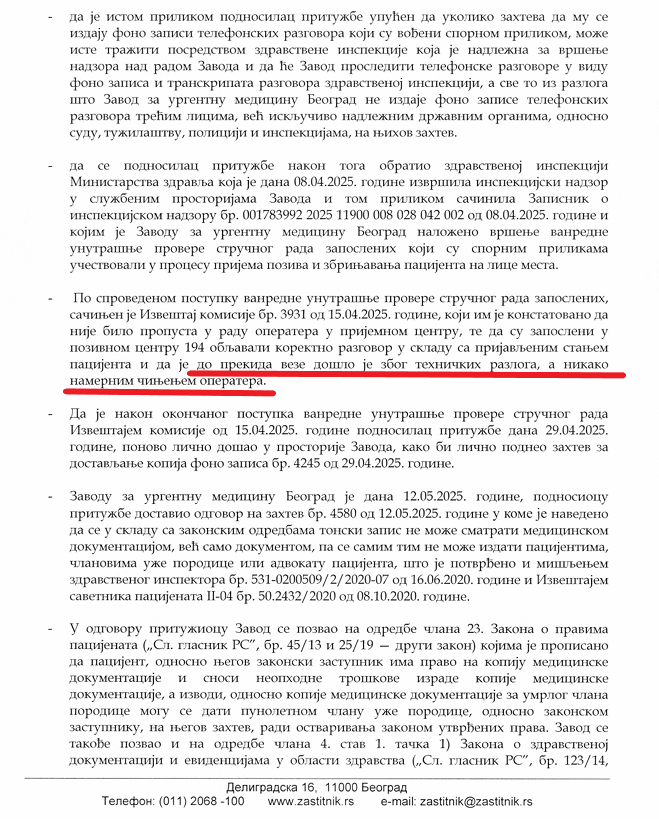
However, the documentation obtained by the Movement, which relates to the report on the operations of the call center at the Institute for Emergency Medicine in Belgrade for February 2025, does not contain data that would confirm the existence of a technical malfunction, system error, or serious incident on February 6, 2025. On the contrary, that report states that in the observed period, no incidents were recorded that would lead to the impossibility of the call center’s operation or serious disruptions in the system’s functioning.
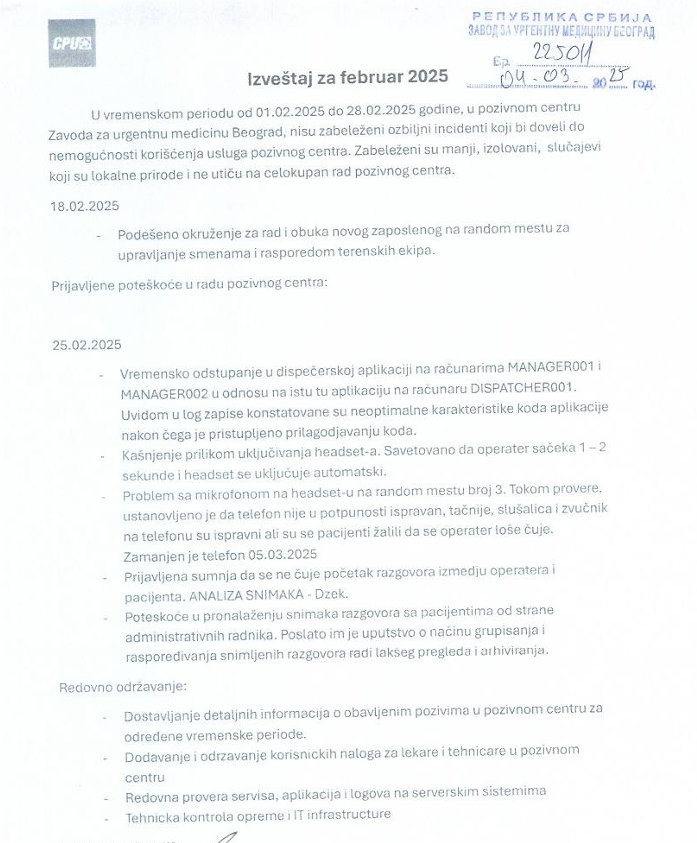
The report mentions minor technical deviations and isolated problems, but none of them relate to connection interruptions with callers in emergency situations, nor is there mention of an event that would correspond to the interruption of the conversation with the patient reporting suffocation. For the day when Zlata made the call, there is no record of a malfunction that could explain the communication interruption.
Such a discrepancy between the subsequent explanation that the interruption occurred due to a technical problem and the content of the internal documentation raises additional questions about the real cause of the conversation interruption. It also raises the question of whether the technical nature of that interruption was ever reliably determined, or whether such an explanation was given without full insight into the relevant technical data and records.
In the context of the case in which the conversation was interrupted precisely at the moment when suffocation was reported, this circumstance further emphasizes the importance of audio recordings and complete documentation, because without them it remains impossible to determine with certainty what exactly happened in the key minutes of the call to number 194.
Not an Incident, but a Pattern
This case is not about an isolated incident.
It is about a pattern.
A pattern in which an institution fails to act in accordance with the law, generates conflict through unlawful conduct, and subsequently relies on that conflict to divert attention from its own responsibility.
A pattern in which the truth is acknowledged only once it can no longer be disregarded.
On Guilt and Responsibility
Ratko Živković is not culpable for seeking compliance with the law.
He is not culpable for persistence.
Nor for reacting in a situation where a legally guaranteed right was persistently denied.
If this case raises a question of responsibility, then the essential issue is not individual behavior, but institutional accountability.
A Question for Society
What does it say about a society in which a citizen who insists on rights guaranteed by law is treated as a problem, while the institution that violates those same laws remains protected from scrutiny?
This question does not concern only Ratko Živković.
It concerns the integrity of the system itself—and, ultimately, all of us.

