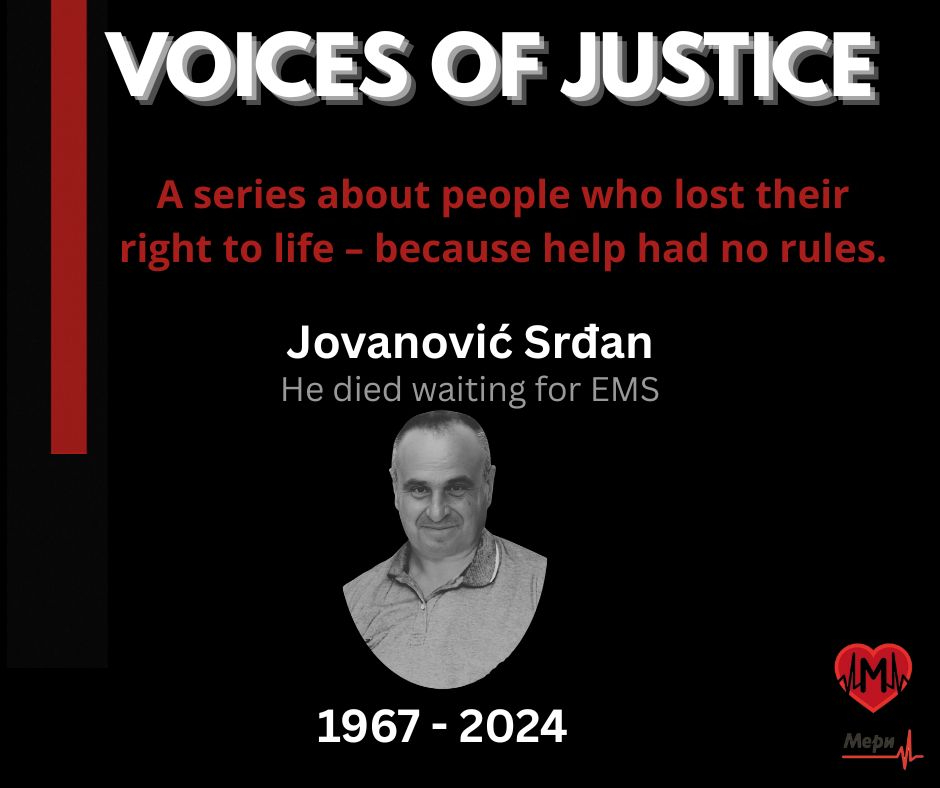
On November 30, 2024, Srdjan Jovanović lay unconscious in his family home in the village of Orašac near Leskovac – Serbia. His family called EMS three times, pleading for help. No one came. As they waited for a team that never arrived, his daughter and wife desperately tried to keep him awake—they washed his face, massaged him, and begged him to open his eyes. But EMS never came. He called for help. He died waiting for EMS.
Srdjan Jovanović was not a number.
He was a husband, a father, a grandfather, a brother, a friend. He was a man who didn’t know how to say “no” when someone needed help. A man who wore out his hands fixing others’ problems but never forgot to welcome guests with a smile and warmth. To many, he was a craftsman. To his loved ones, a hero.
Born in 1967 in the village of Orašac, near Leskovac, Srdjan spent his life working honestly, patiently, and with dedication. As a plumber, he left his mark across Serbia—from Leskovac to Belgrade, and even as far as Moscow and Almaty. Wherever there was a water problem to solve, Srdjan was there—quiet, skilled, reliable.
But what made him truly great wasn’t the tools in his hands—it was the warmth in his heart. His door was always open. He greeted people with a wide smile, a cup of coffee, and the question, “What do you need?”—and he’d jump in to help without hesitation.
To his family, he was far more than a father and husband. He was an anchor in the storm. For his wife, Ivana, he was a companion and a pillar. For his daughters, Teodora and Anđela, he was safety. For his little granddaughter, Darija, he was her first smile, her first walk, her first hug. He had just begun to guide her through life by the hand. He didn’t live to see her first birthday.
And to his brother Radovan, he was a once-in-a-lifetime gift. Born brothers, but spiritually inseparable—without secrets, without friction. Their bond was a beacon, an example of what true brotherly love looks like. On that final day, Srdjan came to see him. It seemed like an ordinary visit, but it would turn out to be a goodbye. Two hours later, Srdjan would collapse in his home, and Radovan would lose the man he’d walked shoulder to shoulder with through life.

The Day the System Left a Family Alone
It was quiet, too quiet for a Saturday. The Jovanović house in Orašac smelled of soup, of the end of the workweek, of safety. They were preparing for an ordinary day—maybe a walk, maybe an afternoon with their granddaughter. Then—a dull thud. Srdjan fell. Without a word. He just collapsed. His legs gave out as if they were no longer there. Ivana was the first to rush to him. Teodora followed right behind. They thought—maybe his blood pressure dropped, maybe it’s just dizziness, they’d give him water, he’d be fine. They knew he had high blood sugar, a weak heart, that he could get tired. But it had never been like this. He lay on the floor. Eyes closed. Face pale. He didn’t move. Ivana instinctively ran to the kitchen—to get water, to cool him down, to do anything. Teodora was already holding his hand, trying to call him back: “Dad? Dad, come on… just open your eyes…” There was no response. Thoughts crashed in their minds. Panic grew, but they still believed—EMS exists for moments like this, when seconds decide between life and death. That calling EMS is a call for life, not for silence. The state exists. The service exists. The system works.
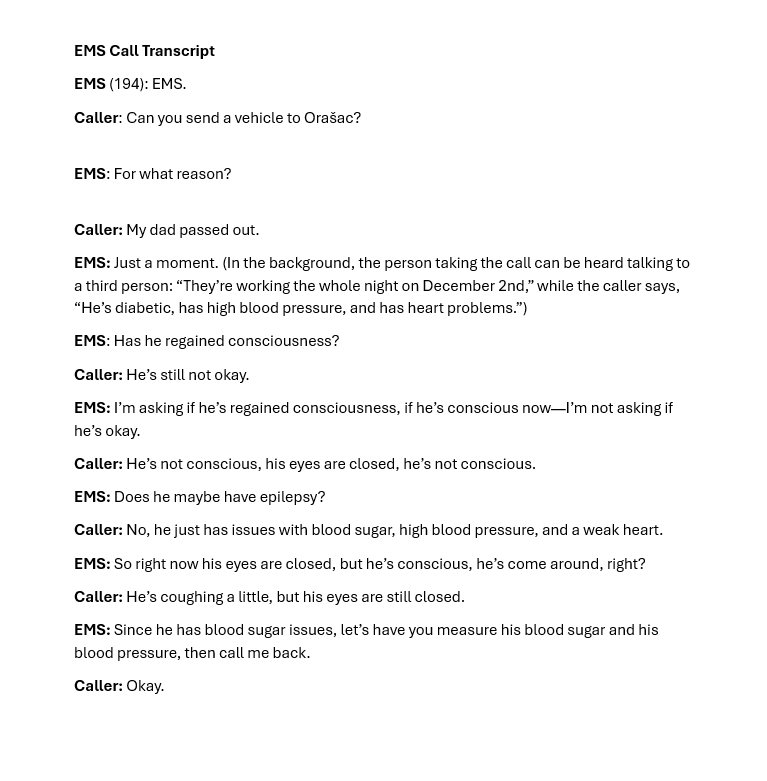
At 12:58—the first call. No one answers.
At 12:59—a second attempt. This time, the health center’s recorder captures 11 seconds of the call. On the recording, you can hear distressed female voices, panic, whispers, and cries: “Dad! Dad!” The phone rings twice—then cuts off with a busy tone.
The third time, someone finally answers. At last. Ivana tries to explain, but on the other end—disbelief.
“Is he conscious again?”
“No, his eyes are closed. He’s not responding.”
“So he’s conscious? He’s come around, right?”
Teodora tries to clarify. Her hand trembles, her words break. Does she need to say something “correct” to get them to come? Is she making a mistake? She wonders: What if my answer means Dad doesn’t get help?
The dispatcher doesn’t send anyone. Instead—they’re told to measure his blood pressure and sugar. To assess him themselves. To decide on their own how urgent it is.
In that moment, they all know the truth. No one is coming.
In the recorded call, you can clearly hear a family member trying to explain:
“Dad passed out.”
In the very next moment, as the caller says the patient has issues with blood sugar, pressure, and his heart, the dispatcher is simultaneously talking to someone in the background about shift schedules. This isn’t just a lack of focus—it’s a lack of respect for the caller who, in that moment, fears losing a loved one.
The dispatcher then asks:
“Is he conscious again?”
The caller responds clearly and accurately:
“He’s not conscious, his eyes are closed.”
But instead of taking this as a clinically significant and alarming symptom—the dispatcher twists the words and makes their own conclusion:
“So right now he’s got his eyes closed, but he’s conscious, he’s come around, right?”
This sentence sets the stage for what happens next—the team doesn’t come. Without consulting a doctor, without seeing the patient, without checking a pulse, pressure, or an EKG—someone decided, based on an assumption, that help wouldn’t be sent.
Instead, the responsibility is shifted to the family:
“Measure his sugar and blood pressure, then call us back.”
This is the moment when the state—through its system—not only abandons a person in need but asks them and their family to judge for themselves whether the situation is serious.
No one asks if they have the equipment. No one asks if they know how. No one asks if it’s safe for them to try anything with an unconscious person.
In that moment, the system stepped back. It hid behind questions, formalities, routine. And a man was left to lie there. And to die.
Left to Beg for Life on Their Own.
In the house—whispers turn to sobs. Ivana holds a towel soaked in cold water. Teodora presses on his chest with hands she can no longer feel. Their voices dissolve into tears: “Come back… please, just open your eyes… Dad… can you hear us?”
Sweat drips down his temples, but he doesn’t respond. His gaze is sealed shut, as if he’s dreaming. They don’t know if it’s a dream—or a departure.
There’s no more time for logic. No more time for waiting. Their son-in-law grabs the phone and calls his father: “Get the car ready. Now. We’re taking him.” The only hope left comes from a village 12 kilometers away.
While others prepare for their afternoon meal, in the Jovanović house, they’re packing a body that’s barely breathing. They wrap him in a blanket, slowly, as if he were a baby—not a man who’s leaving. They place a pillow under his head, quietly, gently—as if that might convince him to stay. Every second hurts. Every word breaks. Because they all feel what no one dares say out loud: he might already be gone.
At 2:23 PM—Srdjan is admitted to the Leskovac Emergency Center. An hour and a half after the first call. His body is cold. Eyes closed. Heart slow. The family’s words go unanswered.
For Srdjan, it’s too late. Far too late. For everything that could have been done—when he was still here.
Srdjan Jovanović died. But what hurts the most isn’t the moment he took his last breath—it’s everything that came before. Everything they had to do alone. Everything no one heard. The phone that rang. The dispatcher who judged. The system that didn’t come.
A man died. And with him died trust. Trust in the state. In the service. In the promise that help exists.
When Institutions Fail, All That’s Left Is Truth—and the Fight
After Srdjan passed, the Jovanović house sank into silence. Not the quiet, aching silence after a funeral. A deeper silence—the silence of institutions. The silence of a system that stayed mute while they called. And kept silent even after it was too late.
In that silence, the family tried to understand: Why did no one answer? Why did no one come? Why was a man who spent his life helping others left alone when he needed help?
In that confusion, as they still counted the days without him, Srdjan’s brother Radovan Jovanović decided he wouldn’t stay silent. A decorated worker in the security sector, a man with over 40 awards for responsibility and honor, he couldn’t accept that his brother died because no one answered a call for help.
In an email he sent to the “Right to Life – MERI” Movement, he wrote simply:
“Yesterday I buried my brother… After the family’s call, EMS refused to come, which was decisive in his death… If you’re able to help us seek justice for the loss of a life due to the irresponsible behavior of the on-duty staff…”

This wasn’t just an email. It was the cry of a man who lost his brother but not his sense of justice. The family no longer trusted anyone—the institutions had failed them. So they sought someone who would listen. Someone who wouldn’t say, “There was no mistake.” They sought the truth. And someone to help them speak it out loud.
That day, their fight became ours.
The Fight Goes On—Because Srdjan Wasn’t the Only One
Srdjan Jovanović had the right to live. He had the right to receive help. To have a team sent to him. To have his call heard and taken seriously.
That right was guaranteed by the Constitution of the Republic of Serbia. It was guaranteed by the Law on Healthcare and the Law on Patients’ Rights. But that day, as for many other citizens before and after him—it remained just empty words on paper.
Because while the right exists, there’s no regulation to enforce it. For five years, the Ministry of Health has refused to adopt the bylaws under Article 83, Paragraph 4 of the Law on Healthcare—the only document that would clearly define how EMS in Serbia should operate.
And without rules—there’s no accountability. Without obligations—there’s no violation. Without protocols—there’s no “error.” Just death that remains invisible, unprocessed, and unacknowledged.
Because of that legal vacuum, Srdjan wasn’t given even a basic chance to survive. He was denied help. And with it, his right to life.
For his death—no one was held accountable.
But thanks to the persistence of his family and the support of the “Right to Life – MERI” Movement, the first steps have been taken. An extraordinary internal review of the EMS service was launched—though it didn’t bring true justice, it opened the door for errors to be documented, compared, and institutionally challenged.
Because what’s in that report—though carefully wrapped in administrative language—confirms what we all know: people are dying, and the system doesn’t recognize its mistakes. Or worse—it refuses to admit that responsibility even exists.
This isn’t the end—it’s the beginning. Because reports like these, though they don’t bring sanctions, prove something more important: the system, knowingly and persistently, avoids setting rules—because without rules, there’s no violation. And without violation—there’s no guilt.
What follows is an analysis of the report that best shows what institutional alchemy looks like: how a human death is turned into “proper procedure.”

1. Form Respected, Substance Missing
The oversight was formally conducted: a commission was formed, documents reviewed, a report written.
But what’s missing is a real critical analysis of the EMS service’s actions. Instead, we get justification:
“The caller stated that someone had fallen unconscious; when the medical technician asked if they suffered from epilepsy, the caller provided information that they were diabetic, had high blood pressure, and a weak heart…”
This actually confirms: the caller repeatedly and clearly stated that this was a person who had lost consciousness and had chronic conditions. And yet—no team was sent.
2. Justifying the Dispatcher’s Passivity
In section 8.3, it’s stated that the medical technician “asked clear and precise questions,” but it’s immediately concluded that “there was no need for a team to be dispatched.”
This is a critical sleight of hand. The dispatcher isn’t a doctor. They didn’t have enough information. They didn’t examine the patient. Their assessment was based solely on a phone call with someone under stress. And on that, a decision was made not to save a life.
3. A Key Admission in the Conclusion
The most important part of the report is the final paragraph:
“The conversation between the caller and the medical technician didn’t last long, and the technician’s suggestion to measure blood sugar and pressure wouldn’t have taken more than a few minutes and would have been very useful for deciding whether to send a team.”
This sentence admits that the decision not to send a team WASN’T based on clear parameters. In other words: they didn’t have enough data, but they still decided NOT to send help.
Conclusion—A Report That Justifies Death
This report is a textbook example of how the system protects itself instead of its citizens.
Instead of addressing accountability for failing to send a team to an unconscious patient with chronic conditions—it’s reduced to bureaucratic repackaging and concealment of failures.
There are no questions asked:
- Why didn’t the technician immediately consult the on-duty doctor?
- Why wasn’t the most cautious approach taken when unconsciousness and heart issues were mentioned?
- Why was the family burdened with deciding the “urgency” in a moment of panic, without equipment?
And most importantly—there are no consequences. No accountability. No admission that someone failed.
This story isn’t an exception. It’s just one of many that go untold every day—in the silence of phone lines no one picks up, in dispatcher assessments that bind no one, and in deaths that no one acknowledges.
That’s why the “Voices of Justice” series exists—to break the silence, to let every family left without answers be heard, and to shine a light on the systemic failures that cost lives like Srdjan’s.
The Systemic Failure of EMS in Serbia: A Call for Change
Srdjan Jovanović’s story is a heartbreaking example of a much larger crisis in Serbia—a crisis rooted in the systemic failure of the Emergency Medical Services (EMS) and the absence of legal regulations to ensure its accountability. In Serbia, the EMS operates in a legal vacuum, with no specific bylaws to define its operations, response times, or responsibilities. For five years, the Ministry of Health has failed to adopt the necessary regulations under Article 83, Paragraph 4 of the Law on Healthcare, leaving the system without clear protocols or consequences for negligence. This lack of oversight means that tragic outcomes like Srdjan’s are not exceptions but part of a recurring pattern where lives are lost due to institutional inaction.
The scale of the problem is staggering, particularly in Serbia’s capital, Belgrade. Each year, the emergency number 194 receives an average of 550,000 calls from residents seeking urgent help. Yet, EMS teams are dispatched to the scene in only 95,000 of those cases—meaning that in 80% of emergencies, no ambulance arrives. This gap highlights a critical failure in the system, where the absence of regulation allows for inadequate responses, leaving families like Srdjan’s to fend for themselves in moments of life-and-death desperation.
We call on the authorities to enact the long-overdue bylaws, establish clear protocols, and ensure that EMS in Serbia becomes a service that saves lives rather than a system that fails them. The voices of Srdjan and countless others must be heard—and their loss must lead to action. Until that change comes, we will continue to raise our voices for those who can no longer speak for themselves. You can explore all the stories in the Voices of Justice series and learn more about this crisis.
We no longer speak just for Srdjan. We’ll speak for everyone. Because they can no longer speak. That’s why we write—to ensure their voices echo beyond the silence.

