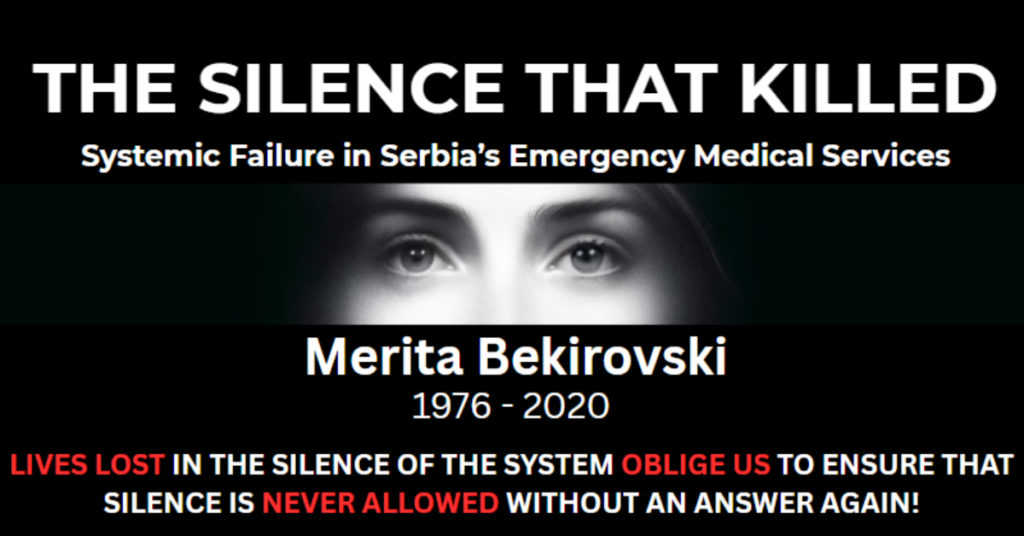
“Lives Lost to Silence” is not fiction, a novel, or a dramatization. It’s a testimony
Introductory Word
This book is not fiction, a novel, or a dramatization. It’s not an attempt to disguise pain as literature. It is a testimony—about a call that went unanswered, about Merita Bekirovski, a woman who loved wood, family, and a simple life, and about the silence that took her away.
(Read the first story in the series, about Stevan Tomičić, a man who lost his life because help did not arrive.)
Merita wasn’t known to the public, but she was everything to us—to me, to our child, to those who shared her everyday life. She was a mother, a wife, a friend, a craftswoman, the heart of our home. She shouldn’t have died the way she did—not in a country with doctors, institutions, and emergency numbers.
I write so I won’t forget. I write so no one forgets what it’s like when the system stays silent, when the line cuts off, when a life hangs on a promise that never arrives. I may not be a writer, a doctor, or a politician, but I know what it’s like to watch a loved one fade while “Please hold…” echoes in your ears.
This isn’t just my story. It’s the story of all of us, because anyone who needs help becomes equally vulnerable, equally dependent on the system. This book speaks of silence—and of the voice that chose to break it. It’s about how pain becomes a fight, how a movement rises from death, how “Meri – Right to Life” was born from loss.
It is a document, an indictment, and a warning. It doesn’t seek revenge, only one thing—that this never happens to anyone else. Every line carries her name: Merita.
She who no longer speaks.
That’s why I write.
Earth in Silence
March 2020. The world knelt before a virus no one could see, yet everyone felt. It crept quietly into daily life—first news from China, then Italy, and soon Belgrade, Novi Sad, Niš. On March 6, the first case was confirmed in Serbia, in Bačka Topola. One man, one sentence from the Minister of Health, and one life that would never be the same. Not his, not mine, not thousands of others. We didn’t know it yet.
On March 15, a state of emergency arrived. Words from history textbooks came alive before us: curfew, masks, empty streets, lines outside pharmacies. Fear in people’s eyes, silence in the hallways. People shrank away from each other, as if even a glance could carry the infection. The earth sank into silence—not the calm, evening kind, but a thick, heavy one, like the air before a storm. It wasn’t just the virus in that silence; it was the absence of certainty, answers, systems.
Six months earlier, I’d returned to carpentry. I started a workshop—wood, tools, the smell of glue and plywood. Merita, my wife, a wood technician, joined me in our plans. As soon as the business got off the ground, she’d work with me. For the first time in a long while, hope stirred. We weren’t just making furniture—we were building a future.
Our son, Đole, turned five on March 10. Too young to understand “state of emergency,” but sensitive enough to absorb the fear in grown-ups’ eyes. For days, I explained why he couldn’t go outside, why Grandma wasn’t coming, why things were no longer as they used to be. Hospitals became fortresses, doctors heroes—but unreachable. Phones rang, answers didn’t come.
In that silence, it wasn’t just a pandemic that began. It was the story of one death—and everything that followed. While the country choked on fear, behind closed doors, one life slipped through our fingers. Soon, many others would follow. For some, help never arrived.
On the Other Side of Silence
The night before, I’d watched Hotel Balkan. Merita and Đole were asleep beside me. After the movie, I got up to use the bathroom. I looked at her—she was sleeping with her mouth open, somehow strangely. I lingered. A thought crossed my mind: “She looks like she’s dead.” I tried to shake it off, but those thoughts stay forever—not because you’re right, but because the body knows before the mind.
That night, I went to bed late, past midnight. In the morning, she woke me as she always did on Easter: “Christ is risen.” It was April 19, 2020. The smell of coffee filled the house, Đole was scampering about. We sat for coffee—our ritual, a quiet moment before the day. We joked about the virus, as if it would all pass. It was easy to believe that then.
Around eleven, I was preparing breakfast, Merita was tidying up, Đole was filming us. I have those videos—on one, she’s laughing and waving at him. We looked like an ordinary, happy family. We kneaded dough for bread.
She went to the yard to light the stove while Đole and I tapped Easter eggs. At one point, I realized she was gone. I found her by the front door, leaning against the bathroom wall, half-sitting. I asked what was wrong—she didn’t answer. She gestured toward her face, quietly asking me to wash it. I was washing her face when she started vomiting, violently, uncontrollably. Đole wanted to come closer, asking what was happening. I sent him back. She seemed to recover slightly, asked me to take her to the bathroom. I helped her, then took Đole to the landlady upstairs.
When I returned, I heard her vomiting again, even harder. I ran for the phone, called the ambulance. The phone rings. Seconds drag on. “You’ve reached Belgrade Emergency Services, please hold.” I clutch the receiver, staring at the bathroom door, calling her name in my mind. “Please hold” echoes again. I took a screenshot—six minutes of waiting. I don’t know why, as if I sensed I’d need proof.

Eight minutes passed, maybe more. Time stopped, leaving only: “Why isn’t anyone answering?” Finally, a doctor—a calm, indifferent voice. She started with questions, one after another, as if randomly made up. I tried to stay composed, believing a team was on its way as we spoke. I said she’d collapsed, was vomiting, couldn’t speak, was drenched in cold sweat, had a pulmonary embolism two and a half years ago. No one was coming.
It was the virus. I didn’t know what to think—maybe the ambulance only responds to “suspected COVID” cases, leaving everything else to the local clinic? The doctor gave me a number: “Call them, they’ll check her blood pressure.” As I tried to make sense of what was happening, Merita quietly asked me to turn her. I helped her. She let out a groan—sharp, deep. It wasn’t ordinary pain.
I called the local clinic. I explained everything—I’d already called the ambulance, my wife was in bad shape, she’d collapsed, she had a history of embolism. Silence. A sigh. Then: “We’re home care, we can’t help, even if we came.” And then the sentence that froze me: “Your wife is in critical condition. Call the ambulance again and insist. Say she has chest pain, that her arm is numb, that she’s choking. Otherwise, they won’t come.”
I stopped. I looked at her—she was breathing heavily, not choking, not complaining of pain, her arm wasn’t numb. I knew those words weren’t said by chance. But should I lie to save her? I was an ordinary man, not a doctor, not a manipulator—just someone watching his wife slip away before his eyes. I put down the phone, sat, repeated their words. My mind was cracking.
I checked on Đole—he was playing at the landlady’s. I forced a smile, patted him, told him to stay a bit longer. I went back. Merita didn’t have the strength to speak anymore. I called the ambulance again, this time from her phone, without thinking. After waiting, a doctor: “Are you calling from the same number as before?” I was confused. “No, this is her phone…” “Call from yours.” I froze—was that even important, or just an excuse?
I hung up, took my phone, called again. Waited. Another doctor. “Her condition isn’t better,” I said. Following the clinic’s advice, I forced out: “She’s choking. She’s got chest pain.” It wasn’t a lie—it was desperation. Today, in the transcript, I see those words. Back then, the tone changed.
It became a test for survival. “She can’t talk, she’s mumbling, I can barely understand her,” I said. “Put her on, let me hear her,” the doctor demanded. I brought the phone to her. Merita whispered, unclearly, as if through a closed mouth. “Ma’am, where does it hurt? How does it hurt? Is it pressing, burning, stabbing?” Barely audible: “In my chest.” “Point to it,” the doctor said. Merita didn’t point. I ended the agony: “She’s pointing to the middle of her chest, below her throat.” Only then did they take our details.
I looked at her, wondering if she was still there. She had to whisper her pain just for the system to acknowledge she existed. The anger faded, leaving only cold disbelief. The woman I love was dying, and I was playing a quiz over the phone. Time was slipping away.
When They Finally Arrived
While I waited, I paced—out to the yard, back to her. I’d check if she was breathing, if she’d moved, then outside again—to listen for sirens, to see if they were coming. It felt like an eternity, but they arrived quickly. The streets were empty; the curfew those days swallowed footsteps and sounds. Only silence echoed.
It was exactly 12:43 when they arrived—almost an hour after my first call to 194. A doctor and a medical technician appeared, both with masks covering their faces. I could only see their eyes.
I quickly explained what was happening. They tried to talk to her, asked her to say how she felt. Nothing. She didn’t respond. She seemed completely absent, uninterested, as if she was already half gone.
The doctor asked her to sit up so they could check her blood pressure. She didn’t react. I stepped in and gently lifted her into a sitting position. At that moment, the technician raised his voice:
“Ma’am, you have to cooperate if you want us to help you!”
It wasn’t harsh, but a desperate attempt to call her back, to pull her out of wherever she was slipping.
But she remained pale, mute, a shadow of who she’d been an hour ago. The doctor started measuring her blood pressure, clipped a device to her index finger—I didn’t know then it was an oximeter. When it beeped, I glanced at her. She said nothing, focused. She measured her pressure twice.
Later, I learned—her pressure was unreadable, and the oximeter showed nothing. Zero. Zero oxygen. Zero time.
The doctor asked the technician to do an EKG. While he prepared the electrodes, she asked me about the vomit and stool. I showed her—I hadn’t had time to clean what she’d thrown up, hadn’t flushed, everything was as it was in the chaos.
She looked at the first EKG. Said nothing, just asked for another. The technician silently set up and ran it again. I watched their every move, confused, trying to read their glances, their hands, the way they breathed. No one told me anything.
After the second EKG, the doctor asked the technician to insert an IV line. He carefully, steadily placed the needle in her left arm’s vein. They started discussing how to carry her out. They brought a cardiac chair, and with it, we moved her and placed her on the stretcher in the ambulance.
As we settled her in, I exchanged a few more words with the doctor—when it started, how it unfolded, what I’d said in the first call. They told me they were taking her to the Military Medical Academy. As she spoke, we heard Merita retching again from inside the ambulance. The technician asked me to grab a bag—just in case. I took one and ran back.
When I returned, the doctor was talking to someone. A brief conversation, then she turned to me:
“Sir, we’re taking her to the Emergency Center instead.”
I didn’t ask why. I just nodded. Everything was already beyond my control.
She got into the ambulance with Merita. Merita kept turning to her left side, trying to vomit. I remember—the doctor held her left arm, the one with the IV, so the needle wouldn’t come out. The doors closed.
I looked at my watch. They arrived at 12:43. Left at 13:01. Exactly eighteen minutes. Long. Too long. When someone is slipping away before your eyes, even a second feels like a century.
I headed back to the apartment, but as I passed under the window, I stopped. I saw Đole. He was standing at the window. I froze. I’d kept him away for this very reason—so he wouldn’t remember, wouldn’t see, wouldn’t carry this image. But fate didn’t care.
To this day, he tells me: “Dad, I remember when they took Mom away…”
And I remember. Every second of that departure. Because it wasn’t just a trip to the hospital. It was—the beginning of the end.
Silence After the Siren
I went back to the landlady’s. I said only one thing: they took her to the Emergency Center. Đole was quiet, didn’t ask anything, just looked at me with those big, persistent eyes. The kind of look that doesn’t demand an answer—because it knows there isn’t one.
We went into the apartment. I grabbed some toy cars to distract him, to keep his mind off things, to stop him from asking, even for a moment. When I saw he was engrossed in play, I started talking to Jelena, our landlady. An older woman, gentle and quiet. She couldn’t believe the ambulance hadn’t come right away. She just shook her head. We talked. Fell silent. Talked again. Fell silent again.
I kept checking the time. Thinking: Have they arrived? Should I call? Or is it too soon? My thoughts were scattered like the toys around the room. I couldn’t hold onto a single one.
My father-in-law called. I didn’t have the strength to answer. What would I say? Pretend everything was fine? Instead, I texted my brother-in-law. Short: Merita’s unwell, the ambulance took her, I’ll call when I know more.
At that moment, it didn’t cross my mind that the end was possible. That in a few hours, we’d be living a different life.
I first called the Emergency Center at 13:35. They gave me one number. Then another. Then a third. They passed me around like an automated operator that doesn’t know where to redirect you. According to the notes I still keep, I called six times before I finally got information—she was in the resuscitation room.
Stunned, I went quiet. Then I asked, more to myself than to them:
“Wait… if she’s in resuscitation, are you saying she’s…?”
They cut me off. Said everyone in critical condition goes there. Advised me to call number 3662.
That was at 13:43. I couldn’t call. I just looked at the landlady. From the look on my face, the way I spoke, she knew something serious was happening. Words weren’t needed anymore.
I called my godfather to tell him what was happening, to say any word at all while I gathered the courage for what came next. A silence was growing inside me. A thick emptiness. I didn’t know how to stop it.
It wasn’t until 14:37 that I found the strength to dial the number they gave me. A woman’s voice answered. I calmly said I was the husband of the patient brought in by ambulance.
Silence. And then—a shift in tone. As if someone on the other end got serious. As if they remembered something they shouldn’t have forgotten.
“Oh… I don’t know what to tell you…”
I didn’t know if I wasn’t understanding—or refusing to understand.
“What don’t you know?”
“Well, you know, we tried everything…”
“What did you try?”
“Well… we did everything we could…”
It was a game. Who would say the truth first? Would she say it—or would I ask?
“Alright… is she gone?”
Silence. And then:
“Yes.”
Like a cold shower. My brain didn’t process it right away. My body didn’t react. I just, automatically, asked the next question:
“What now? What’s the procedure?”
I don’t remember the answer. I only remember looking at the landlady and signaling with my hand, without words. Merita was gone.
The first image that burns into me: I walk to Đole. I hug him, hold him tight. He still doesn’t know. And I… try not to cry, to be strong, to not break him with my breaking.
The first thought: how will he go through life without a mother? Everything stopped. Every thought turned into one: his life has just changed forever.
I didn’t tell him anything. I just sat beside him. I felt a dryness in my mouth, a strange taste—like metal, like stone. Me, who doesn’t drink—I opened a can of beer and downed it in one go.
I called my godfather. Told him what happened. Asked him to come, so we could go to the Emergency Center together. I called my brother-in-law. Told him. Words no longer had weight. Everything felt like some in-between space. Like walking through smoke. I know I’m here, but I don’t know where I am.
And all the while, one question echoes in me:
How is this even possible?
The Black Bag
First, we had to call the police. It was curfew. In this country, when your wife dies, you have to ask for permission. Not to see her. Not to hold her one last time. But to leave the apartment.
I explained that I had to go to the Emergency Center. That my wife had passed away. That I needed to pick up documents. Clothes. The truth. That I had to go to her parents—to tell them what no one should ever have to say.
Ironic, but perfectly precise: the state locked me between four walls to protect me—but when I asked for help because my wife was in critical condition, the system didn’t respond. It didn’t have time. It didn’t have criteria. It didn’t have protocols, urgency, or responsibility.
They denied me freedom of movement for “public health,” but they didn’t ensure my wife—a critically ill patient—received timely care. They took one right away but didn’t protect another. They suspended freedom—but didn’t secure life.
By every European standard, that’s unacceptable. A state cannot restrict citizens’ freedom while failing to provide efficient access to healthcare for those who desperately need it. The moment they took away our right to care for ourselves, they had to guarantee the system would step in. Because if you have the power to ban movement, you have the duty to help. Otherwise—you’re not protecting. You’re taking. You’re not saving. You’re forgetting.
We get permission. We get in the car. My godfather drives. I’m silent. In Belgrade, silence. Nothing rustles—not leaves, not tires on the asphalt. The streets are empty. As empty as I am.
A patrol stops us. They ask briefly, then check. They let us go. They didn’t say anything—but from their look, it’s like they knew.
We arrive at the Emergency Center. I put on a mask. My godfather looks at me:
“Want me to come with you?”
I nod. I can’t do this alone. Not today.
We enter. Everything is white and cold. Disinfectant and the unspoken hang in the air. At the reception desk, I say her name. I say she was brought in today. I say I’m her husband. They look at me like they know. And like they’re afraid to say.
They give me medical documents. And a paper to sign. I ask, “That’s it?” They say, “One more thing.” In the room to the left—a black bag. Black. Bag.
In it—her clothes. The clothes she put on that morning. Maybe with a smile. Maybe while joking about how this whole virus thing feels like a movie. Her shirt. Her socks. Everything left from the day we drank coffee together. Packed. Sealed. Lifeless.
The bag doesn’t smell like her. It holds no trace of her voice. Her smile. Her warmth. No crumbs Đole might have spilled on her while they laughed. Just black plastic.
I take it. Something in me breaks. But it doesn’t let out tears. Just… a dull pain. Silence. Emptiness. Like someone turned off the sound inside me.
I go back to the desk.
“Can I see her?”
“No, we’re sorry. It’s not possible.”
“Can I talk to the doctor who resuscitated her? Just to tell me… something.”
“Unfortunately, no.”
All I get is paper. Permission to be out until 8 p.m., despite the curfew. Because now I have to go to her parents. To tell them what no one should have to say. That Merita is gone.
No more of her voice. Her messages. Her “Christ is risen” that woke me that morning. No more hands that baked bread. No more woman who waved at Đole on camera. Nothing.
Just me. A black bag. And a silence no one can break anymore.
Half a Childhood Without Her
March 16, 2025
I sit and write.
It’s nearing five years since Merita left. Five years since that Easter when our home fell silent. Five years since the world stopped for us—while it kept turning for everyone else.
Đole was five then. Just six days ago, he turned ten. Exactly half his life—without a mother. Half a life where he couldn’t hug her, hear her voice, feel the smile that lifts everything. Half a life without the woman who gave birth to him, loved him, woke him, and put him to sleep.
And as I write this—I can’t believe it. I can’t believe that for five years I’ve been trying to understand. And to survive.
It’s incredible how a person remembers details they didn’t even know they’d memorized. And I… I still remember everything. Every sentence. Every pause between questions. Every silence on the line while I waited for someone to decide if my wife was “sick enough” for help.
For a long time, I wrestled with whether to write this. Was it worth it? Did it make sense? Then I realized—I’m not writing. I’m testifying. Not just about Merita. I’m testifying for every call that didn’t get help. For every mother, husband, child, brother, sister—who reached out to our movement, seeking advice, support, or just a word of comfort. And not once—not once—did that word fail to come. Because I know what it’s like when the system ignores you and stays silent.
That’s why I decided we wouldn’t stay silent. And that my writing wouldn’t be a confession—but a testimony for those no one listened to.
And now, after five years of activism, fighting, reading documents, responses, and hitting walls—I can say freely: I know the consequences of an unregulated system. And I know Merita was one of those consequences.
I write… and I catch myself as my eyes well up. Tears roll down my under-eyes, across my cheeks. Without warning. Without question. Quietly, but decisively. Because on April 19, 2020—I didn’t cry. Not that day. Not for days after. I don’t know why. Maybe it was all quietly building up inside me for years, like water behind a dam, and now, as I write, it surges like a fountain.
Memories. Emotions. Pain. Anger. Disappointment. Hope. It all mixes. It all comes back. It shapes me again.
And as I write, I wonder: Will this text ever see the light of day? Will I have the strength to finish it? Because so much has happened in these five years.
I watch Đole grow into a kind and beautiful boy. And at the same time—I remember evenings when he cried over words he didn’t understand. I remember how, outside our apartment, a doctor from the ambulance service, whose base is right across from our entrance, verbally attacked us. I remember Đole’s look that evening. I remember his fear. The stress he recognized, even if he didn’t understand every word spoken.
And I can’t help but ask: Have we ever truly left 2020 behind? Or are we still there? Trapped. In the same questions. The same hallways. The same walls of silence.
Because not a day goes by that I don’t ask God: Why her? Why her and not me? Honestly—she would’ve been a better guardian for Đole. A better support. A better everything.
But I stayed. To explain. To write. To fight. And maybe that’s exactly why this book came to be. Because if I stayed—then let Merita stay too. In every line. In every sentence. In every voice that called for help—and didn’t receive it.
I’ve tried so many times to explain what remained after that day. But sometimes, a child’s handwriting says more than all the words of adults. This letter Đole wrote in the silence of his room. He was six years old. He didn’t ask anyone to read it. He didn’t write to the Ministry. Or the Medical Chamber. He wrote to his mom.
And I’m publishing it here exactly as he wrote it. Because if any page in this book deserves to stay—it’s this one.

Translation of Đole’s Letter
Dear Mom, why did you have to move to the next life? I know you didn’t want to die, but it’s all the ambulance’s fault. I hope they go to jail for it. But I know you’re watching me from that life in your life. If only I’d heard your last words. I hope we’ll see each other in my dreams.
Signed, your son Đorđe Zejnula
A Funeral Under Restrictions
They didn’t even let us say goodbye properly. First, they told us only five people could attend. Five. As if grief has a number. As if love can be measured. As if there’s a rulebook that decides how many people can love someone who’s leaving.
Five people to hold all the memories, hugs, smiles, jokes, dinners, breads, days when she held Đole’s hand. Nights when she woke him from nightmares. They denied her a chance to survive—and took away our right to a dignified farewell. All in the name of “public health.”
And where was that health when I called? Where were the protocols and order then?
Not a soul at the cemetery. Just the wind. Emptiness. And the feeling that everything that once made sense was gone.
But before that… I had one moment to myself. I asked everyone to leave. A few minutes of silence before it all became irreversible. I didn’t know how to say goodbye. But I knew I had to.
When I was alone with her, I looked at her as if seeing her for the first time, and touching her for the last. She looked peaceful. Unexpectedly so. There was no trace of pain on her face, no shadow of suffering. Just a gentle expression. Almost a smile. As if she was telling me: “Let go now. It’s okay.”
I stepped closer. Leaned in. Kissed her one last time. And whispered: I’m sorry, Meri. I couldn’t save you.
It was a moment when I wanted time to stop. To stay like that, unmoving, my forehead against hers. To keep her with me just a little longer.
The days after… they were foggy. Jumbled. Without voice, without rhythm, without meaning. The only thing with rhythm was me. Every morning, I woke up at exactly 2:30. As if someone had wound me up. As if my body knew, even when my mind couldn’t understand.
That time… between night and day… was my time. That’s when the silence was loudest. I tried to find any kind of meaning. Anything to hold onto.
The apartment was no longer a place to live. It was a place where everything stopped. Whenever I passed the wall she’d leaned against that day, I’d pause. Cross myself. Kiss that wall. As if I was kissing her. As if some part of her breath, her warmth, still lingered there. As if I could hold onto what was gone.
So I packed us up—Đole and me—and moved to my mother’s in Padinska Skela. It was different there. Quieter. Farther. And maybe I needed to be somewhere I could fall apart—where no one would ask why.
Đole still asked about his mom sometimes. I kept preparing him. I’d say she was in the hospital. That the doctors were trying everything. But that sometimes, even they can’t help. I didn’t know how to tell him the truth. I only knew it couldn’t break him—the way it broke me.
In all of that, I tried to stay connected to reality. I went back to the workshop now and then. There was hardly any work. But the smell of wood, the sound of sandpaper, the feeling that I could at least shape something… that was my only escape. My quiet therapy.
But even there, I looked for her. In the workshop she used to visit. Where we made plans together, shared ideas, imagined a future. In every piece of wood, every sketched outline—I tried to find her.
And then, toward the end of April, I decided it couldn’t stay just silence. On April 30, I filed my first complaint with the health inspectorate. I laid out everything that happened. The minutes. The calls. The words. The missed chances. And the belief that Merita might still be alive today—if someone had just chosen to trust me, not the protocol.
And I didn’t stop there. A few days later, I wrote an email directly to the Emergency Services Institute. Polite, but desperate. I only asked them to explain: What happened in the ambulance? Was she conscious? Did she say anything? I never got an answer. Or rather—I did. But not directly. More on that later.

I was in the workshop when the email arrived. Health Inspectorate. The subject line was simple. The tone bureaucratic. Attachment: report on the extraordinary internal audit.
I set down my tools. Wash my face with cold water. Brew coffee. Sit on the edge of the workbench. Open the document. Read. Once. Twice. A third time. I don’t even know how many times I went back over the same sentence: “Conclusion—no irregularities noted in the procedure.”
I stop. As if someone’s ripped the air out of me. I stare at the screen. Waiting for something to appear, for a line to pop up: “We’re kidding.” Nothing.
So… is someone mocking me? How can there be “no irregularities” when my wife died? How can there be no irregularities if no one even tried to seize the chance to save her?
In that moment, nothing can pull me away from that document. And yet, everything in me wants to escape it. I lower the laptop lid like I’m closing a coffin. I look around—everything’s in its place, but nothing feels right to me anymore.
Confusion. Rage. Disbelief. The feeling that someone’s spat in your face, laughed, and said: “She didn’t even exist to us.”
I go home. Try not to think. Take Đole to the park. He laughs, runs, plays, calls me to see what he’s made in the sand. I nod, try, pretend I’m there. But inside, one question: Have they all decided to forget this except me?
Evening. I put him to bed. He tells me about school, stars, drawing. Says: “Dad, Mom sees me now, right?” I pause. Nod. And lie to him again—to save him. Just like the system lied to me—to save itself.
Ever since I told him they “couldn’t find a cure for Mom,” sometimes he’d just get up, walk to the corner of the room, and sit cross-legged. Arms folded, staring at one spot. Not sad—angry. A child’s face that says nothing but says everything.
He’d sit like that for half an hour. Not speaking. Not asking. And this is a kid who can ask a million questions in a day. I didn’t touch him. I let him get it out—his way. To understand what I, at forty-four, couldn’t.
So I chose my words carefully. And my tone. When Mom comes up, I answer only if he asks. And only as much as he asks. Short. Clear. Enough not to break him. Not too much, not too little. The way a heart can bear.
When he falls asleep that night, I take the documents. Open the laptop. Don’t sit at the table. Sit on the floor. Surround myself like trenches—papers, reports, printed messages, my notes. On the table beside me: coffee, water, an ashtray, and silence.
The internal audit report. Medical reports: cardiologist, neurologist, surgeon, resuscitation unit. I read the notes: “Soporozna… agitirana… hemodinamski nestabilna…” I don’t understand. What do these words even mean? How do I know if someone’s lying if I don’t speak their language?
I start. One by one. Open Google. Search medical terms. Find abbreviations. Compare dates. Look for sequences. Ask people. Learn. Not to be smarter. But to break their shielded “no irregularities.”
Because if there are no irregularities—where’s Merita?
That night, I stay up until two in the morning. Tired. Exhausted. But for the first time, with a sense I can do something. Not to change what happened. But to keep it from being forgotten. To stop it from happening again. So they can’t tell anyone else: “Everything was by procedure.”
That night, I didn’t cry. Didn’t curse. Didn’t break anything. I just decided I wouldn’t stop.
Here, People Die
I realized I was missing one document: the Emergency Medical Team’s report. Until then, I didn’t even know where Emergency Services was located. Honestly—I thought it was just a team from the Emergency Center, maybe a room in the Clinical Center, something between an ambulance and a hospital. I had no idea it was a separate healthcare institution. Its own system. Its own building. Its own courtyard. Separate administration. Separate walls.
I go. At the entrance, I explain what I need. They politely direct me to the legal advisor. Point the way. “Through this entrance, up to the first floor, left through the restaurant. Office 18.” You remember those directions when they mean more than any map.
I climb the stairs. On the floor—a restaurant. Two people in red uniforms eat and laugh. Their laughter rings like a slap. Merita’s gone, and here they’re eating beans and telling jokes.
I find Office 18. There it is. I knock. Open the door. An older woman sits at a desk. “Good afternoon, is this free?” “Come in, what do you need?” The legal advisor. Her name’s Milica.
I introduce myself. Explain. Say I want a copy of the medical documentation. I only recently learned this, flipping through the law—Article 23, Paragraph 2 of the Patients’ Rights Act. It says the closest relative of the deceased has the right to all medical records. That’s how clueless I was—I didn’t know I could ask for it. Or that it was my right. Or that it existed.
I hand her the death certificate extract. Bureaucracy runs its course. In passing, I mention I sent an email. That I asked to meet the team from that night. To explain—not legally, not criminally—humanly. For someone to tell me what happened. Because my wife died. And I thought, surely, I deserve at least some explanation.
Then something happened that changed the course. It wasn’t the first time the system pushed me. But it was the moment I felt the full force of that push. The legal advisor, without a hint of malice, said: “Sir, what’s wrong with you? This is Emergency Services. People die here. Imagine if the teams met and explained to everyone like that.”
She left the office to get the documentation, and I stayed alone. “People die here.” It echoed in my head. No, it didn’t echo. It screamed.
People die here. Isn’t it the opposite? Isn’t Emergency Services where lives are supposed to be saved? Isn’t the whole point of this place to keep people from dying? But no. There, in the building with a red cross on the doors and ambulances, I was told: “People die here.”
And then I realized: They’re not here for us. We’re just a number to them. An entry in a table. And yes, people die here—but no one talks about it. People die here—and the system lives. And no one cares.
If I want the truth to survive, I’ll have to preserve it myself. And if they can say that without shame, I can’t stay silent without disgrace. That day, I stopped asking for answers—and started collecting them. That’s when I realized: you don’t find the truth here—you lose it.
I left that building a different person. No longer a man begging. But one who records. Remembers. And doesn’t forget. I don’t know how or from where, but that day, something clicked in me. Not hope. More like stubbornness. If I can’t change the past, maybe I can stop it from repeating.
And so began my first steps… through the fog.
First Steps Through the Fog
I had no plan. I didn’t know who to write to, where to start, how you even do it—when you want to ask the state: Why did you kill my wife? But I knew one thing: I couldn’t stay silent. Because if I did, the truth would too.
First, I wrote to the Health Inspection. The only way I knew how. No legal jargon. No formula. Just a sequence. Seconds. Words from the recording. Questions that echoed: Why didn’t they come right away? Why did they send me to the Health Center? Why did they demand I call from the same number?
I didn’t get an answer. Or I did—but the bureaucratic kind. Cold. Clean. Sterile. The kind that goes in a drawer labeled: Closed. No irregularities.
Then I wrote directly to the Emergency Services Institute. Asked one thing: What happened in the ambulance? Was she conscious? Did she say anything? Just that. No accusations. No rage. Just one desperate human question. They didn’t answer. At least not to me.
There was one more thing—to get the conversation transcripts. To complete the story. To have it all in one place. Or so I thought then. I called the health inspector. Bane. Another key figure in the years of my fight ahead. I asked him to send me the transcripts of the conversations mentioned in the internal audit report. He was kind, at least then. He quickly scanned and sent them. Less than an hour later—I had them.
That evening, I sat on the floor, papers scattered around me, and started analyzing. I read the transcript—and something odd catches my eye. At one point, the doctor asks for the address. I answer: “Maršala Tita 45.” The transcript says—“Višnjica 45.”
I pause. Read again. And again. God knows how many times. I know I said she was struggling to breathe. But that’s not in the first part of the conversation. If the audit was based on this text, something’s off. The address is wrong. Some sentences are missing. I start to suspect the transcript is incomplete.
At the top, it says the conversation lasted from 11:59 to 12:06. I start a stopwatch and read the transcript aloud, at the pace I spoke then. Less than five minutes. But the document claims—at least six minutes and two seconds. Something’s not right.
I draft an email requesting a copy of the audio recording. I cite the Patients’ Rights Act. The Emergency Services’ response comes quickly: “Audio recordings of conversations between callers and operators in the 194 Call Center are not provided to patients or immediate family members of deceased patients due to potential misuse. Audio recordings are released to the court and the Ministry of Interior upon their request.”
I send the same request to the Health Inspection. Get the same answer. Wait… hold on. How do I not have the right to access the audio of a conversation that’s the key evidence in my case? I start to realize my instinct wasn’t wrong. Something’s being hidden. And it’s not all as the report claims: “No irregularities.”
The days that followed grew heavy. Every evening, after putting Đole to bed, I’d sit on the floor. Open the laptop. Search. Compare. And each time, my mother would come in and say: “You’ll lose your mind. You’re not normal. What’s the point when you can’t fight the system?” And I’d stay silent. Because I couldn’t even explain to her that I’d already lost my mind—just quietly.
Nights were spent researching. Learning about things I didn’t know existed. Regulations, jurisdictions, laws. Rights I didn’t know I had. And then, among hundreds of websites and texts, I stumbled on a sentence: “Every citizen has the right to appeal to the Ombudsman.”
I stopped. Until then, I didn’t even know that institution existed. I was just a guy who worked with wood, never imagining I’d learn how laws work, who protects patients’ rights, what jurisdictions mean. Yesterday, I didn’t know the difference between a healthcare institution and a health inspection. Now I had to understand laws, protocols, responsibilities. And I didn’t even know where to start.
But now… Now I had no choice.
The Truth That Must Not Be Written
I reached out to the Ombudsman. Honestly. With facts. No legal jargon. No polish. I said everything. The timeline. The injustice. The system’s silence. It was the first time I felt I was addressing someone who might have humanity in them. Not an operator, not an office. But someone who could hear—a person. A father. A husband.
The pressure builds. A choking feeling. I make a decision: we leave the apartment. I pack our things, take Đole, and we move to the workshop. There’s a small office there, an improvised room. For now—enough.
While searching for a new place, I learn. I research. I write to the Medical Chamber, requesting an investigation. I send a letter to the Ministry of Health—a demand for an extraordinary internal review. I believe I can get answers. That there’s someone honest, someone who’ll say: “Yes, the system failed.” Naive. Or just a wish to believe. Because if I lose faith—I lose Merita.
In the meantime, old school friends reach out. Offer help. From the heart. But I—refuse. Pride. I’m barely making ends meet, but I still refuse. Because the fight I’m waging… it’s not something you share.
Amid it all, I start emailing media outlets. Begging them to publish the story. To write an article. For someone to hear. But there’s no response. Not yet.
I look for someone to guide me. Someone who’s been through something similar. Who knows more than I do. And I find an article. A former director of the Institute, who once pointed out suspicious practices. I read about him for days. What he said, what he went through. Turns out—he went through hell. Those who speak the truth rarely get off easy.
I discover he now works at a private clinic. I call. Ask how I can reach him. They say—only through an appointment. I’m out of money. But I book it. Because maybe he—finally—can explain what no one else has. Maybe he’ll look at me as a person—not a number in a table.
I didn’t know what to do next. I just knew I couldn’t stop. By day, I worked. At night, I pored over documents, transcripts, laws, constitutional articles, others’ testimonies, medical terms I translated with Google. I searched for an apartment. Searched for doctors. Searched for the truth. And above all—searched for meaning in it all.
One doctor saw me in his office, no hesitation. Reviewed everything, listened. And said quietly, as if he didn’t want to say it too loudly: “They made a mistake.” He didn’t charge me a dime. Just gave me a few pointers. Humanly. Saw me out with respect.
But the next encounter was one I’d remember for a long time. I found a court expert’s name on an official list. He worked at his private practice near Cvetkova Market. I went straight from work, a folder of documents under my arm. No glamour, no hope, just quiet determination.
He received me. Professionally. Carefully reviewed everything I brought. The call transcript. Medical records. The timeline of calls. He nodded. “A huge mistake was made here,” he said briefly.
I thought: here it is. Someone who can write what everyone sees but no one dares sign. I pulled out 200 euros. Not as a bribe. Not as pressure. But as a man ready to pay for the truth to be written, whatever it was. Offered honestly, regardless of the official fee.
He looked me in the eyes. “Please don’t ask me to do that,” he said softly. “I have a daughter. She’s finishing medical school. If I write this report, I’ll close the doors of medicine in Serbia to her forever.”
I wasn’t angry. I wasn’t disappointed. I just knew. This was no longer a fight for one truth. It was a fight against a system that doesn’t allow the truth to become words. And the fact that this expert was appointed Assistant Minister of Health in 2024 shows that the system rewards compliance.
In that moment, everything I’d felt as a personal tragedy began to transform into something more. A duty. I didn’t know what step I needed to take. But I knew it had to be bigger than anything I’d done before.
I started digging deeper. Leafing through laws, regulations, decisions, notes from parliamentary committee sessions. In every letter, I searched for a gap, a trace, a signal.
And then, after countless exchanges with the Emergency Medicine Institute, a moment came that was another trigger. In their official work information booklet, I found a sentence that chilled me: “Calls within the call center constitute medical documentation.”
Exactly what I’d been claiming for months. I sent them a letter. Soon, the legal advisor, Milica, called me. A conversation began that, to this day, remains one where I first saw clearly how the system protects itself, not the truth.
We exchanged arguments. I was calm. And persistent. I told her: “What I’m claiming is in your official work information booklet.” She laughed. Loudly. And said: “Oh… that was entered by mistake. I just corrected it. It’s not there anymore.”

I was speechless.
Speechless. The moment I relied on the only official document I held in my hand, the system erased it. That’s when I knew: I’d have to take another path.
I didn’t have money for a lawyer. But I had time. And will. For months, I spent evenings with the Healthcare Act, the Patients’ Rights Act, the Administrative Procedure Act. Taking notes, underlining, connecting the dots.
And I decided to draft a complaint myself. A misdemeanor charge. Not out of vindictiveness. But because if I’m still just one man against the system, then at least that man won’t stay silent.
The moment they erased the truth from the documents—I decided, for the first time, to pour the truth into a legally articulate form. That evening, I knew: this was no longer a fight for Merita. This was a fight for everyone the system wipes away like a footnote.
The Opinion That Stopped the Truth
In the weeks following my request for an extraordinary external quality control of work, a response arrived. Not a decision. Not a report. Not a commission’s minutes. But a document titled “opinion.” Signed with a name that didn’t yet mean much to me. Assoc. Prof. Dr. Marko Ercegovac. Chairman of the Republic’s Expert Commission for Emergency Medicine.
The text, citing documentation provided by the Institute, stated there were no grounds for conducting an extraordinary external review. In short: “There is no need to investigate the work of an institution” that refused to provide urgent medical assistance and waited until the condition became irreversible before acting, nor the institution where my wife died.

At first, it sounded like a routine commission assessment. Another wall. Another bureaucratic response. But something wouldn’t let me rest. Some intuition that had guided me from the start. I can’t explain it any other way except as a feeling that she, Merita, was still leading me. As if she whispered: “Don’t trust it, it’s not over yet.”
As someone who knew nothing about healthcare, procedures, or laws—I, against all logic, kept digging. Where most would say, “You got an answer,” I said—something here doesn’t add up.
I started checking. And I uncovered what that paper didn’t say: The document presented as the “opinion of the Republic’s Expert Commission” didn’t actually come from the commission’s work. There was no meeting. No minutes. None of the commission members were consulted. The opinion wasn’t collective. It was personal.
And what makes it especially heavy is the fact that the same Dr. Marko Ercegovac was also the director of the Emergency Center where Merita died. In other words, the institution that was supposed to be audited. One man. Two roles. Objectivity vanished the moment those two roles merged into one signed sentence.
Only later, when I dove deeper into the fight, built contacts, and began what would become the Movement, did I obtain documentation that confirmed it: minutes from the Republic’s Expert Commission meetings showed that no session was held regarding my request. No discussion. No decision. Just a signature.
And that signature was enough to close the door. To avoid reviewing the actions. To snuff out the light over one life.
So I wrote to him. Directly. No curses. No threats. No hatred. Just questions:
Did you, as the director of the institution where the tragedy occurred, think it was right to be your own filter of truth?
Did you know there was no therapy despite a recorded diagnosis?
Did you know symptoms were concealed and calls mishandled?
Are you aware that with your signature, you didn’t protect the system—but yourself?
And at the end: “I don’t want to file a lawsuit. That’s proof I truly want only the truth. And I’ll either get to it—or die. Because I won’t give up until I have answers.”
That’s when I admitted to myself, for the first time, what I’d long felt: This is no longer a fight against mistakes. This is a fight against a web of power and institutions doing everything to keep the truth buried.
I didn’t wait long for a response. Not because the system became efficient—but because the response consisted of dodging responsibility. Another letter arrived, signed by the same name—Dr. Marko Ercegovac. This time, not an opinion, but a cold redirection: “Contact the health inspection… we don’t communicate directly with complainants.”
No rebuttal. No discussion. No attempt to explain. Just legal form. The language of the system. And behind it—silence.
Of all the questions I asked him—not one got an answer. Not because the questions were bad. But because the answers were too dangerous.
So now, when I look at that second paper, that second signature, I know one thing: They didn’t reject me because I was wrong. But because I was right—and too persistent for them to let me in.

When I Believed in People Again
In the meantime, I managed to find a small house and move. It was modest but quiet, and for Đole and me then—more than enough. I needed a space without rushing, without noise, to gather everything breaking inside me. I was still alone, but I was no longer lost.
Those days, Nada reached out. My classmate from elementary school. Once the class president, always caring and organized. She started asking what was happening, how I was. Then one day, she just said, short, no beating around the bush:
“Listen, let go of pride. I’ll organize a fundraiser, just give me your account number.”
I didn’t know what to say. My first reaction was resistance. Discomfort. Pride. But then, days without a dime, with a zero balance, with urgent needs—I gave in. Sent the number.
And money started coming in. A little. Then more. Then again. They were familiar names from school days, some even forgotten, but their hearts hadn’t forgotten. In just a few days—nearly a thousand euros. From old classmates.
I don’t know how to describe exactly what I felt then. There was gratitude. Disbelief. A bit of shame. But above all—a sense that I wasn’t alone after all.
In a world where institutions were blind and deaf, where truth was dangerous, where words came at a cost, this help was proof that someone still had a soul. That solidarity still existed. That humanity still existed.
These were the kids I spent eight years with in a classroom, sharing snacks, desks, and schoolyard fights. And now, those same people were the first to extend a hand.
A few weeks later, I wanted to thank Nada. I called her one evening. We started talking, as if decades hadn’t separated us. She asked how I was progressing, how things were going. And at one point, hesitantly, I said:
“Nada… I want to ask you something. Please don’t laugh. It might sound stupid, but… I can’t believe the resistance and wall of silence. I’m afraid I can’t push this through alone. What do you think—how much stronger would my fight be if I started an association? If I acted as a legal entity?”
She paused. And then came a reaction I didn’t expect—excitement.
“Deki, you’ve called the right person for this. I work at an NGO, and I know exactly how it works. I can help you set it all up.”
I knew where she worked, but honestly, I had no idea what that meant. That night, we talked past midnight. Our call dropped three times—back then, calls were capped at 60 minutes. And each time, we’d reconnect, as if we hadn’t stopped.
She explained step by step: how to form an association, what’s needed, what the statute must include, how to register it, what legal status would bring… And for the first time in a long, long while—I went to bed with a smile on my face.
It wasn’t a smile of victory. Or comfort. It was a smile of hope. Because that evening, for the first time, I saw a way out that didn’t go through the system’s doors—but through the doors of people.
Đole’s Traces
While some signed opinions without discussion, my son was learning to write the letter “M.” While some erased traces, he left traces of socks on the hardwood floor. And that, perhaps more than anything, kept me alive.
We moved. From one end of the city to another. That meant a new address, a new start—and a new kindergarten. As a single father, I had priority for enrollment, and for the first time, Đole went to a public kindergarten. Until then, he’d been in a private one, paid monthly.
He adapted quickly. Faster than I could get used to the silence in the apartment when he wasn’t there. He made new friends, learned new songs. Brought back a smile to his rhythm. But he’d often mention missing the old kindergarten. Not for the toys or teachers, but for the sleepovers.
Once a month, every first Friday into Saturday, the kids would stay overnight at the kindergarten. They’d watch cartoons, eat popcorn and pizza, play board games. A little movie night, a mini party—and great joy. He missed that a lot.
I tried to make up for it. As much as I could. Every free moment, I used to talk, play, take a walk. Weekends we spent at Ada Ciganlija or Kalemegdan. Playing, running, sharing rolls with pigeons. But all those streets, all those paths—they were memories. Images of the three of us. Merita, Đole, and me. Now it was just the two of us.
I know, some would say—many people die, many kids lose their mothers. And that’s true. But it’s not the same. Not when you know she might have had a chance. Not when you know the system decided that chance didn’t exist. Not when you know a call was erased as a mistake.
It wasn’t just grief—it was the defeat of truth.
From time to time, Đole would ask me: “Dad, why didn’t the ambulance come sooner?” I never had an answer. How do I explain something the institutions wouldn’t explain to me? I’d just look at him, pat his hair, and say: “I don’t know, my love. Dad’s still trying to find out.”
But Đole didn’t know that. I didn’t show him. I tried to be cheerful, gentle, present. And I believe he never felt what I carried inside.
We did kindergarten assignments together. Built a birdhouse for a teacher’s project. He painted the roof, I tried not to get in his way. He was proud when we hung it on a tree.
We had a little ritual too. Every night before bed, we prayed together. It was a moment of peace. Silence. Safety. Even now, he does it alone, every evening.
One morning, he woke up different. All happy, smiling, lively. He got up, and I, like every morning, went to kiss him and ask: “Good morning, my love. Did you sleep well? Did you dream something nice?”
Usually, he’d say: “I don’t remember.” But that morning—he paused. Smiled even wider. “I dreamed of Mom.”
It caught me off guard. “Really?” I asked quietly, my throat tightening.
“Yeah. She was at a white job.”
“What do you mean, my love? What white job?”
He looked at me sincerely, the way only a child can. “There was this big white room. Everything was white. The walls, the floor, the light. And Mom was there, dressed in white. She was standing at the end of the room.”
“And what did you do?”
“I ran. I hugged her. And she said to me: ‘Where’ve you been, little cat?’”
I didn’t ask him anything more. I didn’t need to. I let him go get dressed. And I stayed standing. In that silence. In that image I didn’t see—but felt.
I don’t know where she was. I don’t know if it was a dream or something the soul creates when it longs to see someone who’s gone. But I know it was true. For him. And for me.
That dream calmed me. Gave me a sliver of peace I hadn’t felt in a long time. I believed she sent us a message. To tell us she’s okay. That she’s watching over us.
And I couldn’t help but connect it to that look of serenity on her face when I said goodbye to her for the last time. That morning saved me. That morning, I believed she somehow, somewhere—sees us. And waits. As she said then: “Where’ve you been, little cat?”
The Day the Movement Was Born
It was December 7, 2020. The day Merita would have turned 44, something was born that wasn’t a plan, a wish, or a project. It was a reaction. A cry. A refusal to live in silence.
That day, the Movement “Right to Life – Meri” was founded. The name came naturally, almost as if it already existed, just waiting for someone to say it aloud.
That day, we didn’t celebrate her birthday. That day, we decided no one else should have to remember birthdays through pain.
It wasn’t a whim or the idea of some bored activist. It was resistance—from a man who lost everything but still chose to stand.
Nada was the one who made the first moves. She drafted the statute, found the form the law required, called people. She didn’t wait for me to figure out how—she knew I was barely breathing then.
She called Urke and Ana, our school friends from Dorćol. Eight years together in the classroom, now together in the fight. Papers started circulating: first to Urke, then to Ana, and finally to me. It wasn’t just paper anymore. It was proof we wouldn’t stay silent.
We all grew up on the same streets. Shared snowfalls, soccer games, summer breaks, and school hallways. We didn’t know we’d one day share a fight against the system.
When Merita died, I didn’t know who to call. But life sent me the ones I grew up with—the ones who mourned with me and now said: “Enough.”
The four of us founders—Ana Vidaković, Uroš Lučić, Nada Likar, and I—didn’t come together by chance. We were connected by the same elementary school, the same courtyard, the same hallway fights and skipped classes. We shared sandwiches and notebooks, but we didn’t know we’d one day share the weight of a fight against the system.
Ana shared elementary school with me and later four high school years with Merita. Uroš finished high school in Cyprus but returned to Serbia with experience that would be invaluable to the movement. Nada became the driving force—persistent, patient, organized. And we all knew: if anyone could write a statute while planning dinner for her family—it was her.
I designed the movement’s logo. A beating heart with a big “M.” Because it wasn’t just Merita’s heart. It was the heart of everyone who didn’t get help. A heart that stopped—but now beats again.
Marijana, another school friend, brought it to life graphically. She drew what I couldn’t. And so, the movement took visual shape.
Ana opened Facebook and Instagram pages. I chased down institutions—papers, registrations, an official stamp for an association that, time would show, would make more noise than many “serious” organizations. Urke was everywhere I couldn’t be—filing papers, signing, running. He was logistics. He was a brother.
We didn’t have offices. No secretary, no PR, no funds. Our “office” was a 28-square-meter studio I’d moved into to save every dime that, like a rabbit, kept hopping out of my pockets. In that tiny room, ideas were born, conversations held, messages sent, plans made. I gave up a lot—comfort, peace, even privacy—to make the Movement live and survive. But that was my firm choice. Between bread and justice, I choose justice.
Even before we officially registered the movement, someone heard that cry. The first journalist to write my story was Milica Rilak. She published an article in June 2020—“My wife died, the ambulance didn’t come on the first call.” A sentence you read once—and it stays forever.
Soon after, Bojana Milovanović published another piece—about a fight that doesn’t stop, about a man who rejects “that’s how it had to be,” about fathers who become associations.
People started reaching out. Some just said, “Thank you, now I know I’m not alone.” Others shared their stories for the first time. The Movement didn’t yet have a name on a door—but it already had a face among the people.
That article forced the system to glance back. And me—to realize I was no longer alone.
But the Movement’s mission—that Serbia must have an emergency services law—didn’t come by chance. I go back a few months. During a conversation with the Institute’s legal advisor, Milica—the only person available at the Emergency Services Institute while directors and those responsible remained out of reach—I mentioned that the symptoms I reported on the first call were exactly those listed in the urgent care index as first-degree emergencies.
She shrugged and said: “Those are just protocols, guidelines. They’re not binding. The doctor decides.” And that’s when I was told something I’ll never forget: “Serbia has no law that would oblige doctors to follow internal protocols.”
If the rules don’t apply, there’s no system—just luck or death.
That meant Serbia had no legal basis to protect a patient’s life when they call for help. In the region and beyond—all countries have clear laws and binding protocols. Here—the decision about a chance at life comes down to the intuition of whoever’s on the other end of the line.
And that’s when the Movement found its mission. Not just to tell the truth. But to turn it into law.
And a third article, on February 16, 2021, was the first time the public heard what became the official mission: an Emergency Services Law.
We had only a name that could no longer fade into oblivion. And Merita wasn’t the only one. Time would show there were hundreds, maybe thousands, who died before reaching their right to help. Merita was the beginning.
And that’s why this wasn’t a personal fight. It was the start of something that would later become much more than an association.
The Movement didn’t come from an idea. The Movement was a response. To injustice. To silence. To a system that forgot what it means to be human.
That was the day the Movement was born. Not from politics. Not from business. Not from ambition. It was born from an empty bed, a quiet room, and a boy who asks: “Dad, when’s Mom coming back?”
The First Message
We didn’t even know anyone knew we existed. The “Right to Life – Meri” page was still fresh. No campaigns. No marketing. No famous faces. Just truth. And a cry, quieter than all the news that day.
And then—on January 23, 2021—a message arrived. Long. Heart-wrenching. Sincere. It was from a woman named Ana. She wrote: “Good evening, my name is Ana, and on January 15, a terrible accident happened to me in the hospital in Sremska Mitrovica…”
She described pain that doesn’t stop. The loss of her baby. Doctors who don’t listen. Midwives whispering, “I can’t say anything.” They told her to wait, and she was losing her child. She waited, and lost everything.
But what froze me more than anything was one short part of her message: “The midwives referred me to you.”
Healthcare workers. The ones the system calls invisible. The ones who carry births in their hands but have no right to speak. They said: Contact them.
In a country where healthcare stays silent, someone from within pointed to us. And that was the moment I first realized: this isn’t a fight against all doctors. This is a fight for those who can no longer stay silent.
At the end of her message, Ana wrote: “My goal isn’t a lawsuit or money and that’s it. I’d rather achieve something with that lawsuit so no other woman has to go through this.”
I stood over the keyboard, staring at the screen, not knowing what to write. It wasn’t just a message—it was the first trust.
In that moment, I knew the Movement was no longer just mine. And that Merita didn’t die in vain.
I started writing to her as if writing to myself. Explaining, comforting, finding a way to help. I outlined her rights, explained how to request documentation. I told her it’s okay to be afraid, but that she has rights.
And most importantly—I said what I had to tell myself: “Those who’ve lost don’t seek revenge. They seek to ensure no one else has to lose.”
I realized—all these people aren’t seeking revenge. They want one thing: for the system to, just once in its life, look in the mirror.
Ana wasn’t asking for a spotlight. Not for media, money, or attention. Just truth. And just that what happened to her wouldn’t be someone else’s next story.
That day, I understood the Movement wouldn’t grow through ads. Or political speeches. It would grow as one message after another came from someone’s darkness.
And nothing was more important than responding. It didn’t matter where I was, whether I had strength, whether I was broken. Someone believed we had power. So we had to have it.
In the days that followed, we kept writing. Encouraging her. Helping her take the first steps toward accountability. We knew it wouldn’t be easy. We knew it might not reach the end. But she was no longer alone. And neither were we.
That’s why that message will forever be etched in the Movement’s foundation. Because it wasn’t just the voice of a woman in pain. It was the voice of all those who stay silent. Who no longer believe anything can change. Who lose someone dear every day and tell no one.
Today, I know—every one of those messages was proof Merita didn’t die voiceless. And every response we sent was our way of saying: “We’re not alone anymore.”
And that was just the first message. Soon, more started coming. And we realized—Merita wasn’t the only one. And no one is invisible anymore.
The Court of (No) Honor
I submitted a request to initiate proceedings with the Medical Chamber on June 9, 2020. It was one of the first steps I took after Merita’s passing. I didn’t know how to draft legal submissions. I didn’t know how the system breathes. But I knew it wasn’t normal for someone to die and no one be held accountable.
I wasn’t asking for a firing, prison, or revenge. Just for someone, even once, to say it could’ve been different. To say: “Yes, we failed.”
The Medical Chamber’s first response was as cold as a form letter. A decision came to dismiss the case. They didn’t conduct an investigation. Didn’t request transcripts. Didn’t call me or the doctor. Just dismissed it. No proceedings. No questions.
Every such letter… every such paper was a slap. At first—disbelief, powerlessness, disgust. But then, after that initial blow, something in me rises. And says—no. Not like this. Not now.
I didn’t know how to write an appeal. I only knew something in me refused to accept this was possible. That you call emergency services. Say your wife is lying down, can’t speak, is drenched in cold sweat, was mumbling, had a prior embolism. And no one comes. And then, everyone shrugs like it’s normal. In a country. In a system. In a healthcare system we paid for.
And I couldn’t move. In a country where they take away your freedom to move but don’t guarantee your right to an ambulance when you call—how do you even call it? A system? Or a prison without walls?
I write line by line, rereading the transcripts. Comparing every record with every document. Describing how the doctor ignored the prior embolism. How she didn’t ask a single question about breathing. How she cut me off when I tried to explain Merita couldn’t breathe from uncontrollable vomiting. How I said she was drenched in cold sweat, mumbling, unable to talk. And how someone called that a “collapse” and told me to cook her soup.
And, as if the world shifted for a moment, a new decision came from the Medical Chamber: there are grounds to proceed. Only after my appeal. Only then do they acknowledge both sides should be heard. Only then does something that should be justice begin.
Seventeen months passed from the request’s submission when a hearing was finally held and questioning conducted. Transcripts become documents. Words that were a cry are now paper. For the first time, the documents list symptoms they’d pushed aside until then. Not because they admitted them—but because they could no longer ignore them.
That morning, as I prepared to finally see the face of the person who took Merita’s chance at life, my heart pounded like it wanted to break my chest from the inside. For the first time, I had the chance to look into the eyes of someone who decides whether another will live or not, whether they’ll get a chance or be left without one.
When they asked me to describe what happened, I spoke quietly, without hatred, without accusing. I didn’t ask for a license revocation, not even a penalty. Just a warning and one human acknowledgment. One sincere “Sorry, we made a mistake.”
And then something happened that shocked me more than any document before. I pulled out the Urgent Care Index—an internal document of the Institute itself, a guide healthcare workers use to determine urgency by symptoms. I showed them that the symptoms I reported in the first call—altered consciousness, cold sweat, inability to speak—were all marked as top-priority emergencies.
The chairman of the panel looked at me, stunned, and asked how I even had that document. And then said that—since I’m not a healthcare worker and medically uneducated—I can’t use it in the evidentiary process.
In that moment, I was speechless. If even their institution’s internal protocol can’t be used to prove a mistake, on what basis will anything ever be acknowledged? By what parameter? By whose criteria?
Because what followed was no less devastating. When I later received the decision that there was no liability, and the reasoning behind it, I realized the problem wasn’t just inaction. The problem was how facts are selected. It’s not about what happened, but what they choose to record.
Because they didn’t analyze what was critical—altered consciousness, inability to speak, cold sweat, prior embolism. They didn’t ask the question aligned with the Urgent Care Index. Instead, they noted: no chest pain, no bloody vomit, loose stool.
As if the symptoms were chosen to justify the actions, not evaluate them. As if they were looking for an excuse, not the truth.
That was the pattern. Primary symptoms—what screamed for urgent response—were pushed into footnotes. Secondary symptoms—what fit the narrative “it wasn’t that serious”—were elevated to decisive.
It’s not a coincidence. It’s a method. That’s how the circle closes. A mistake becomes an exception, and death—collateral damage. That’s not protecting a profession. That’s covering up responsibility.
After all that, the decision: the doctor is cleared of liability.
But it’s not the end. I write a new appeal, this time to the Supreme Court of Honor. I list the exact call times. Point out inconsistencies in the documentation. The omitted symptoms. The protocols not followed. That you can’t say “there were no irregularities” when a patient says they’re struggling to breathe, and no one asks how they’re breathing.
And then, the worst sentence you can hear: “There was no harm to the patient’s health or endangerment of life.”
My wife is dead. But, apparently, the system says her health wasn’t endangered.
It’s not just cynicism. It’s institutional gaslighting. You didn’t see it right. You didn’t say it accurately. It didn’t happen the way you know it did.
In that moment, I realized: The Court of Honor isn’t a place where the profession’s honor is protected. It’s a place where a wall is built around every mistake so it doesn’t become truth.
And if you call that honor, then let this chapter stand recorded as: The Court of (No) Honor.
What I didn’t know then, but know now, is that this experience became an invaluable lesson. I saw how the system defends itself. How it erases traces, rewrites sentences, selects truth. And that knowledge, no one can take from me.
In the days that followed, that knowledge became the Movement’s foundation. Because I was no longer seeking justice just for Merita. I was seeking it for every person the system prepares to tell—“there was no harm to health”—while they stand over a grave.
And that’s why the Movement didn’t start from an idea. It started from a wound.
The First Project
I didn’t know you could survive through projects. I didn’t know there was any donor who might fund something you genuinely believe could save someone’s life. To me, it all seemed like a world I didn’t belong to. Until Nada said: “It’s possible. And you should try.”
She eased me in. Showed me websites listing calls for proposals. Explained what public interest means. How projects work. What applications look like. I was lost. Concepts, structures, logic. Like you’ve been thrown into a plane and told: fly.
But then a call came from the Belgrade Open School. They were seeking proposals for public advocacy projects. I felt—this is it. For the first time, I sat down and wrote a project, not because I knew how, but because I had no other way to make my voice heard.
We wrote and rewrote the project at least ten times. We knew what we wanted. We knew what hurt us. But we didn’t know how to shape it into project language. Every sentence was a struggle. But when we finally sent it, I knew I’d given it my all.
Weeks later, an email arrived. The start felt like a rejection. The tone, the formality. But then I saw a sentence that changed everything: “Your project has been approved, with support in the amount of $5,000.”
I was thrilled. Five thousand dollars? To me, that was huge. For the first time, someone was giving money to continue the fight for life. But Nada quickly brought me back to earth. “Don’t get too excited,” she said. “It’s small money for all we plan, but enough to get the Movement functioning.”
And she was right. That small grant was the initial spark. Because by then, almost a year of pain and injustice was behind me. Everything the institutions did to me, every response without accountability, every document erasing truth—it all prepared me. Showed me exactly where the problems were. And which way to go.
And somewhere, quietly, in all of it, I felt Merita’s invisible hand. As if she was guiding me. As if she was saying: “Keep going.”
In that moment, I knew for the first time that something I started wasn’t just staying on paper. The Movement was becoming real.
Uroš and I went together to the first kick-off training. I’d never been to anything like it. A room with tables in a circle, a projector, name tags, roll-ups, organization on point. And all of it for us. The first feeling was like being an elephant in a glass shop. Like every move I made was too much. But the second feeling, the one that stayed, was: something serious is starting.
A story begins where you’re no longer alone.
From a movement born of pain, a space for change emerges. And it carries a name: So It’s Not Too Late.
The project’s idea was simple but powerful: to ensure the voices of citizens who experienced failures in emergency services aren’t lost in the system’s silence. We planned a series of public forums and gatherings in Belgrade, Novi Sad, Niš, and Kragujevac, where we’d present cases, data, and experiences of families who lost someone due to delays or inadequate responses from emergency services.
Beyond that, we designed a campaign, “So It’s Not Too Late,” to inform citizens of their rights in emergencies. We distributed leaflets, conducted a survey on experiences with the 194 number, and prepared legal proposals to reform the system.
The goal wasn’t to attack, but to point out. We weren’t seeking culprits, we were seeking mechanisms to prevent mistakes from repeating. We weren’t fighting against doctors, but against silence.
Because truth isn’t defended with sentences. It’s defended with actions. And this was our first.
To be continued…
To fully understand how a system designed to save lives turned into one that profits from silence,
read the companion investigation:
Earning While People Die
LIVES LOST IN THE SILENCE OF THE SYSTEM OBLIGE US TO ENSURE THAT SILENCE NEVER AGAIN GOES UNANSWERED!

