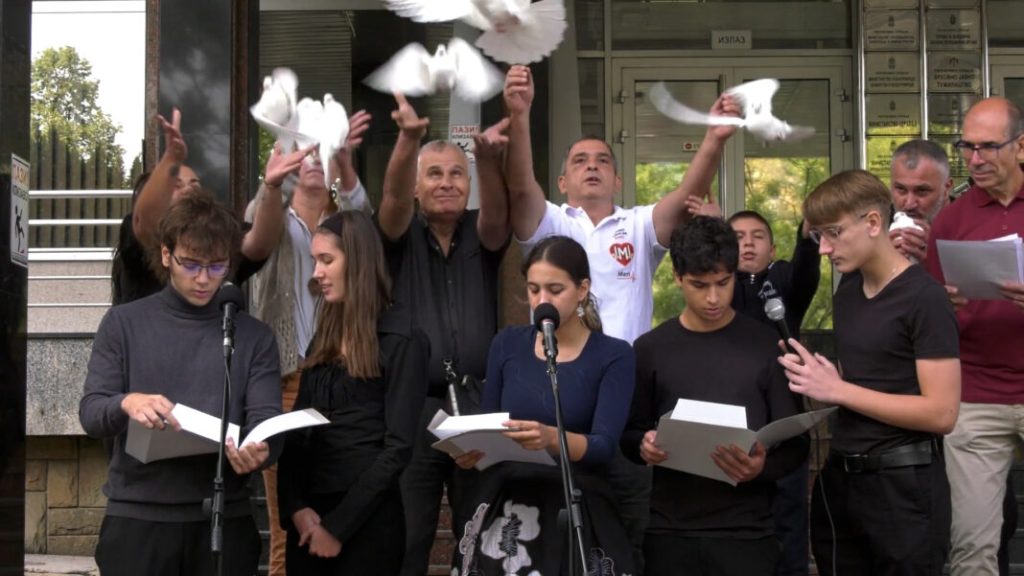
The MERI Movement brought the “Voices of Justice” in front of the Ministry of Health on September 17.
The right to life is not a privilege. It is the foundation without which society crumbles – and when the state forgets that, families are left alone in the face of silence. Because of that silence, we gathered in front of the Ministry of Health: not to count tragedies, but to bear witness to the truth – the state has denied the right to life, and this is no longer an individual failure, but a consequence of a system that does not exist.
In front of the ministry stood a row of ten empty chairs. On each – initials, city, and years of life. Without names, without capital letters, just black on white. Each chair was a place that should have been occupied by a person, but was taken by the silence of the system. A white flower on the backrest reminded us that these are not numbers, but lives cut short while the state remained silent.

The gathering was opened by a choir performing the song “Cveta trešnja u planini” (“The Cherry Tree Blooms in the Mountain”). That quiet, dignified song set the tone for what followed: testimonies from families in the “Voices of Justice” series, performed as a unified performance. These are not fictions or dramatizations, but the living voices of those left without their loved ones – and who today demand the most basic thing: that a call for help never again goes unanswered.
This gathering was not just a protest; it was a record of the state’s absence and a vow that, as long as life has “working hours” and death works overtime, we will speak clearly: life must be above everything.
Opening Address
In the atmosphere created by the choir, the host opened the program with a quiet but powerful address. “Today, we are not here to celebrate, but to bear witness. To bear witness to lives that were extinguished because the state failed to fulfill its first and greatest obligation – to protect the right to life.”
He reminded everyone that these are not fictions or dramatizations, but the bare truth – stories of people who called for help and were met with silence. “Families died twice: first with their loved ones, and second when they realized the state would not stand by them.”
This clearly conveyed that these are not accidents, but consequences – consequences of a non-existent system, laws that remained dead letters on paper, and a state that has remained silent for years while citizens lose their lives.
The program was hosted by Miloš Đajić, an activist and communications expert – founder of the Center for Modern Skills, campaign strategist, trainer, and blogger.
Speech by the Association President
On behalf of the “Right to Life – MERI” movement, President Dejan Zejnula addressed the gathered crowd. His speech was a testimony of pain turned into a fight.
“The MERI Movement was not created by people, but by institutions – through their inaction, silence, and cover-ups. It arose from rejected calls, false reports, and cold bureaucratic sentences.”Zejnula emphasized that the movement’s goal is clear – Serbia must get a law on emergency services. And he added: “It is tragic and shameful that we even have to demand it. The right to life should be taken for granted. It should be a human, humane, sacred right – that when you call for help, it arrives.”
He recalled the words of Duško Radović: “Marriage is regulated by law only when it can’t be otherwise.” – and stressed that this is exactly why we are demanding a law on emergency services today, because the state itself refused to protect the lives of its citizens.
In the end, he thanked his son, a symbol of the fight and the strength to not forget this crime: “He is the reason I haven’t given up for five years. As long as I have his gaze and his faith – this fight will continue.”
The message was unequivocal:
“The right to life is not a privilege. It is the foundation of every other right. And we will not stop defending it until every voice and every life in this country is safe.”
Symbolism: “SYSTEM” Tape
After the opening address, family members came to the microphone one by one. After introductions and opening sentences, a black tape with the inscription “SYSTEM” was placed over their mouths – a sign of the attempt to silence the families’ voices. The tape stood as a shackle: a sign of the legal vacuum, bureaucratic coldness, and all the “procedures” that turned life into silence. While they stood with the tape, the movement’s president, as support and witness, continued their story instead – with sentences that institutions refused to hear. And then, toward the end of each testimony, the families removed the tape and completed their own testimony with clear, unequivocal messages. In the silence after the last sentence, what the paper persistently hides became visible: the state has denied the right to life – and tried to deny the right to a voice.
Voices of the Families
Radica Rudakov spoke about her father Marinko, a man who worked his whole life, paid taxes, and believed there was a system – and then, on that January night, heard that “Emergency services do not respond after 7 PM.”
“My father did not die by chance. He died from a system that does not exist. He died because the absence of rules means the absence of responsibility.” Radica reminded us that in Serbia, not only does a person die, but dignity as well – because after her father’s death, official papers stated that a ‘detailed examination’ was performed, even though no one ever saw him.
Radica ended her address with a question: And so today I ask Minister Lončar – how many more fathers must die in silence before we finally say: ENOUGH?

Jovana Tomičić spoke about her father Stevan – Buca.
“We called three times, begged three times, screamed three times – and three times heard the same: ‘Bring him yourself.'”
Her father passed away in front of the family while the state refused to respond. “My dad did not die naturally. He died from neglect, from a legal vacuum where there are no protocols, no responsibility – so no guilt. Just death and silence.”
Jovana’s message was: This is not an unfortunate accident; this is the consequence of a system that does not exist. And until the system exists, none of us is safe!

Radovan Jovanović testified about his brother Srđan from Leskovac:
“At 12:58, the first call – no one answers. At 12:59 – busy. Only on the third try, a voice on the line… but not help.” Instead of a team, the family received instructions to measure blood pressure. Srđan passed away at home while neighbors turned into an ambulance. “My brother wasn’t killed by one person. He was killed by a system that does not exist. A state that refuses to adopt bylaws, and so instead of justice, we have only funerals.”
Radovan’s message was clear: For Srđan. For all our brothers, sisters, and children. For the right to life, which is not a privilege – but the state’s obligation.

Ratko Živković spoke about his wife Zlata, but also about the humiliation that followed when he tried to learn the truth. “When I asked for audio recordings, they told me I couldn’t have them. When I raised my voice, they looked at me with smirks. And then they accused me – not for what I did, but for what I refused to forget.”
Ratko told the institutions: “I’m not a dangerous man. Dangerous is the system that allows a woman to die without help, and declares her husband guilty for asking about her voice.”

Demands of the Movement
After these addresses, concrete demands were presented – so that this silence gets a response from the state, not another excuse. We demand:
- Revision of all “extraordinary external controls” in cases of fatal outcomes due to delays or non-response of emergency services – because it is absurd to claim “there were no failures” where rules didn’t even exist.
- Urgent adoption of bylaws and protocols on the operation of emergency services (within 90 days), aligned with ERC/ESC recommendations – so that the number 194 once again means help, not silence.
- Ban on commercial engagements of emergency services while teams are lacking for citizens, with public records and sanctions for every violation – life is not a commodity.
- Dismissal of the leadership of the Institute for Emergency Medicine in Belgrade due to a series of abuses and negligent work, as well as receiving a delegation of families by the minister to deliver the demands.
With these demands, we conveyed: these are not individual cases – this is the consequence of a system that does not exist.
Special Moment – A Child’s Voice
After the harrowing testimonies from families, a moment followed that left the audience breathless. The host announced Đorđe Zejnula, the son of the movement’s president.
“There are words that hurt more than any speeches. There are questions that no minister, no doctor, and no judge will ever know how to answer. And those questions are asked by a child – to the one who is no longer there. While adults write complaints and submit demands, one child wrote a letter. A letter to his mom.”
Đorđe stepped in front of everyone present, not as a politician, not as an expert, but as a child who lost his mother. The letter he read, which he wrote at less than 6 years old, was stronger than any report or verdict – a testimony that tears the heart and shows the truth: that one child in this country had to learn what a legal vacuum means.
Closing of the Gathering
After the families’ testimonies, the presented demands, and the poignant letter from Đorđe Zejnula, a moment of silence ensued. The audience breathed together with the child who, in his handwriting, uttered the truth that the state has hidden for years.
The host then addressed in a quiet, calm voice:
“After these words, there is nothing more to add. One child has said the truth that institutions dared not write. So let this gathering end not with words – but with a message: the right to life is not a privilege. It is the foundation of everything. And as long as the state denies it, we will not remain silent.”
At that moment, the choir sang the song “Cveta trešnja u planini” again. The families released white doves, and their flight into the sky was a symbol of freeing the truth and hope.
The image of doves above the Ministry of Health remained to speak what institutions tried to silence: that the right to life must never again be subject to bureaucratic silence, but an inviolable obligation of the state.
LIVES LOST IN THE SILENCE OF THE SYSTEM OBLIGE US TO ENSURE THAT SILENCE NEVER AGAIN GOES UNANSWERED!

