
The lack of emergency medical protocols Serbia led to a nine-year-old girl’s tragic death—just days before Christmas. She dreamed of Santa Claus, but a systemic failure stole her future.
Due to the absence of emergency medical protocols in Serbia, a nine-year-old girl’s life was tragically cut short—just days before Christmas. She dreamed of Santa Claus, but a systemic failure stole her future.
She was only nine years old. She dreamed the dreams all children do, eagerly awaiting Santa Claus, who was supposed to arrive in just two days.
She didn’t get the chance to write her first poems, though she often said she’d become a poet one day. She didn’t finish learning her division tables, but she knew how to share a smile with everyone around her.”
“Her drawings adorned the walls of her home—colorful worlds where there was always room for dragons, unicorns, and kind hearts.
She was one of those children whose gaze made you wonder how so much tenderness and wisdom could fit into such a small being. She loved to ask “why?”—not out of stubbornness, but from a genuine thirst to understand the world. She had plans: to learn to play the guitar, to write a book, to master making “that strawberry cake.”
But above all, she had a life ahead of her. One big, unopened gift.
In those days, she was writing a letter to Santa Claus. The Christmas tree was already decorated, a paper snowflake taped to the window. She didn’t ask for much—just a book and a plush horse. And one New Year’s Eve she could stay awake to see. She was happy, excited, and she believed—because she still believed in miracles.
On December 28, 2024, while others were planning where to ring in the New Year, she was at a small celebration with her uncle. They didn’t have much, but they had each other—and enough reasons to laugh. They listened to music, lit sparklers on the balcony, and made plans to toss a coin for luck at midnight.
She ate something sweet, maybe too much, but who counts at the end of December? Her uncle remembers how she hummed a melody he didn’t recognize, how she lit sparklers and tried to catch the mist of her breath in the cold air.
That evening, they watched a cartoon together, and then she slipped under the blanket and whispered, “Just one more story, then I’ll sleep.” She laughed, tired from a day full of play and twinkling lights. Then she fell asleep—peacefully, with a faint smile, as the glow of the Christmas tree lights danced across the ceiling.
Nothing that day hinted at an ending. Everything smelled of beginnings.
Around five in the morning, a sharp pain in her stomach woke her. She didn’t cry; she just quietly got up and stumbled to the bathroom. Soon, the sound of vomiting echoed. Her uncle first thought it was spoiled food or too many sweets, until he saw her return—pale, hunched, clutching the wall.
Halfway back to bed, her body simply gave out. As if someone had switched off the light inside her. She collapsed to the floor without a sound. First her knees buckled, then her shoulders. Then silence.
Her uncle rushed to her, calling her name. She didn’t respond. She was breathing, but faintly. Her eyes were half-open, as if she were slipping away even while still there. He tried to lift her, to get her back to bed, to bring her back to life with trembling hands.
“Come on, come on, sweetheart, just lie down… come on…”
But she couldn’t. Her head slumped onto his shoulder. And then panic set in. His hands were too slow, the phone too far, the light too dim, time too sluggish. Everything went quiet—not the quiet of fairy tales, but the quiet that tells you something is irrevocably changing.
In those moments, when your child lies helpless on the floor, unable to speak their own name, you don’t think. You don’t look for blame. You don’t check the time. You just call for help.
Her uncle grabbed the phone. His fingers shook as he dialed 1-9-4. That was supposed to be the number for salvation. The number that doesn’t ask questions—it just comes.
Because that’s what we all believe: that somewhere, there’s a system. That behind the line, there’s someone trained, ready, obligated to help. That there’s a state that doesn’t ask if it should help, but comes because it must.
But they didn’t know the system didn’t exist.
The doctor on the line asked questions—not to understand the child’s condition, but to find reasons not to send a team. Each follow-up question felt like a pre-prepared filter for refusal, not an attempt to help.
“Does she have a fever?”
“What did she eat?”
“How many times did she vomit?”
When she heard that the child was lying on the floor, unable to stand, barely responsive, she didn’t take it as a call for urgent action. She took it as a complication disrupting her routine. Instead of treating the information that the child “can’t move” as critical, she asked a question that explains everything:
“Well, how are you going to transport her? Taxi, car… Why are you asking me?”
There was no medicine in those words, no empathy. Just the defensive wall of bureaucracy. Instead of seeking a solution, she sought an excuse. As if she weren’t speaking to a desperate man holding a helpless child in his arms. As if the distraught citizen were the problem, not a symptom of a system that had crumbled.
And then, her uncle broke. Not because he was reckless, but because he no longer knew who to turn to.
“Because you’re the emergency service!” he shouted. “Because you take money from people who pay taxes to this damn state! If I were some bastard from the SNS, you’d have come, wouldn’t you? That’s the trick, isn’t it? Does a child have to die on the floor?! Does a child have to die?!”
It wasn’t cursing. It was collapse. The cry of a man who no longer begs, because he knows there’s no one to beg.
In that moment, he wasn’t just an uncle. He was every citizen who ever called the state—and got silence.
Suddenly, a male voice came on the line—a doctor who, by all indications, had no idea what was happening on the other end. The uncle, at the edge of his strength and sanity, repeated the question that had gone unanswered from the start:
“Just tell me how to transport her. I can’t move her. The child is lying down. She can’t stand.”
He paused, as if searching for air he could no longer breathe. And then, broken, he erupted in despair:
“I told your colleague—if I were some bastard from the SNS, you’d have come! But like this—who gives a damn! You didn’t come for my dead mother! If I were someone from the party, someone with a position—you’d have come!”
And then—the response.
One sentence, delivered almost mechanically:
“Sir… sir, you’re a bastard even without the SNS. Have a nice day.”
Click. The line went dead.


Maybe that man truly didn’t know. Maybe no one told him that a little girl lay on the floor, unable to speak, move, or breathe properly.
But that’s the tragedy. In that sentence. In that hung-up phone. In the absence of any basic human response.
That morning, it wasn’t just the system that failed. Empathy failed. Professionalism failed. Responsibility failed. Healthcare failed. The state failed.
Everything failed.
The phone slipped from his hand. He didn’t have the strength to pick it up. He no longer knew who to call.
It was half-past five in the morning. The child lay on the floor, barely conscious. Her head rested on his arm, her breathing shallow, her body cold.
Around them—silence. Walls. Darkness slowly losing its battle with the gray of dawn. And in his mind—chaos.
He racked his brain for names. Who could come? Who has a car? Who’s awake at this hour? Should he call a taxi? Can a taxi driver take a child who can’t sit up? Who do you turn to when the system hangs up on you?
Helplessness wasn’t a word then. It was the room. It was everything.
Somehow, they managed to get her to the hospital. To the doctors. To the system that was supposed to pick up where the emergency service left off.
But it was too late.
The girl passed away that same day, in the afternoon. While others walked through holiday crowds and planned their New Year’s celebrations, one family was left with nothing. No meaning. No answers.
And no child who just wanted to stay awake for New Year’s Eve.
In this country, you can pay taxes, believe in institutions, teach your child to call 194 in an emergency—and still be left alone.
This wasn’t an accident. This was the consequence of a system that doesn’t exist. The consequence of laws that aren’t enforced. Of a ministry that, for five years, hasn’t issued the regulations the law demands.
This is the result of a state that hasn’t written down when a life must be saved—so today, no one has to.
In this country, if you’re not “someone,” your child can die on the floor. And the only response you’ll get is—click.
After New Year’s, the family gathered what little strength they had left. They turned to a friend, a lawyer, believing that at least in the justice system, someone would say, “This shouldn’t have happened.”
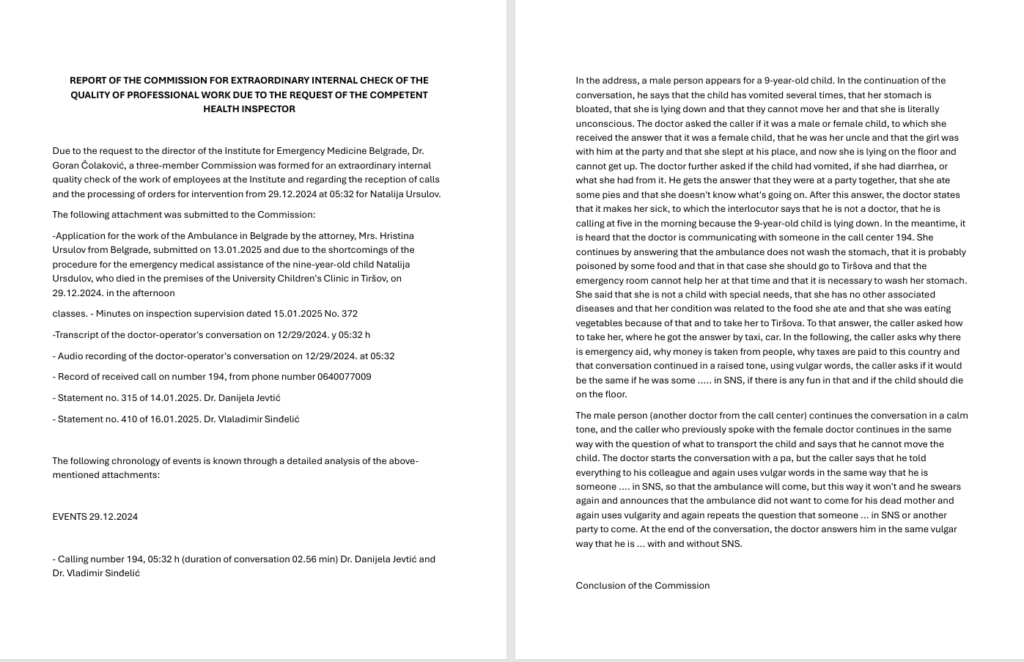
And then came the first response—an internal review report from the Emergency Medical Service.
What they read wasn’t insight. It wasn’t an investigation. It wasn’t the truth.
It was a second blow. A second death.
Because a family dies again when they realize the state won’t stand with them. That the system isn’t there to protect citizens and patients—but to protect itself.
The report contained no admission of error. No compassion. No names. Just cold bureaucratic language in which a child isn’t a child, but a “call,” and an uncle’s panic—“difficult communication.”
It didn’t matter that the child lay on the floor, unable to stand, that help was refused. What mattered was that protocols were “not formally violated.” What mattered was that the system didn’t admit it failed.
Because if it did—it would have to change.
So, instead of justice, the family got a report that silenced them. Instead of accountability—blame-shifting. Instead of acknowledgment—a cold document stating that “all procedures were followed.”
And the procedure, let us remind you, didn’t even exist.
When a Report Seeks Excuses, Not Truth
The internal review report didn’t provide answers. It didn’t bring clarity. It didn’t reveal the truth.
It delivered another slap.
Instead of recognizing failure, the report tries to mask it—to cover up the doctors’ responsibility and turn a desperate man’s frustration into a problem that needs “communication improvement.” In that document, the child didn’t die due to systemic neglect. She died because the caller “hindered communication.”
Because when a system wants to preserve itself, truth is the first thing erased.
The internal review not only ignores the core issue but attempts to discredit the uncle—a man who, at dawn, holding a lifeless child, begged for help. They call him agitated, aggressive, as if emotion in such a moment is inappropriate. As if he should have stayed silent and waited, accepting without reaction that the system wouldn’t send a team—while the child died on the floor.
This narrative isn’t a mistake. It’s a strategy. Deliberate and cold.

Because admitting fault would mean admitting the system doesn’t work. And that’s what this system fears more than any death.
Instead of addressing the fact that the doctor refused to send a team despite serious symptoms, the report carefully chooses words to protect the institution. Not a single point acknowledges professional failure. Instead of confronting the mistake, it offers a “recommendation for communication improvement.”
Moreover, the doctor’s own statement makes it clear that consulting a colleague wasn’t for clinical purposes but solely to “calm the caller”—as she herself put it, “using male authority.”
Despite this, the internal review report includes the phrasing:
“It cannot be determined with certainty whether a team would have been dispatched after consultation with a colleague.”
This artificially creates room for doubt, even though the doctor’s own statement shows the consultation wasn’t even attempted to reassess the medical decision.
In other words—the system claims it doesn’t know if it would have helped, even though all evidence shows it never intended to try.

So, the problem isn’t that the child didn’t get help. The problem is that someone demanded too loudly that their child not die.
But what really happened isn’t in the report.
This isn’t analysis. It’s an excuse. It’s an institutional shield placed over its own mistakes.
While the family buries their child, the system writes reports to bury responsibility.
Voices of Justice—Stories That Must Not Remain Untold

*This is the fourth story in the series “Voices of Justice”, through which the Right to Life Movement – MERI documents the testimonies of families who lost their loved ones due to systemic failures in emergency services—and due to the silence that kills.*
This story comes from Belgrade. It is not backed by cameras, political positions, or famous names—just one child. One letter to Santa Claus. One number that didn’t answer.
Read the first story, about the death of Stevan Tomičić from Bačka Palanka, to whom an emergency team was not sent despite multiple calls for help, here:
Read the second story, about the death of Merita Bekirovski and the beginning of the fight that sparked an entire movement, here:
Read the third story, about Marinko Rudakov, who was left without help because they don’t respond after 7 p.m., here:
If we stay silent, there will be more. If we write, we remember. If we speak, we fight.

